
Ideas
Organizations are living ecosystems.
An organization is more than a structure to be designed or a machine to be fixed. It is a living system of people, relationships, culture, structures, systems and resources, all shaping one another inside a wider environment.
What it means to think of an organization as an ecosystem
Thinking of an organization as an ecosystem means paying attention to how its parts affect one another, not only to how each part performs on its own.
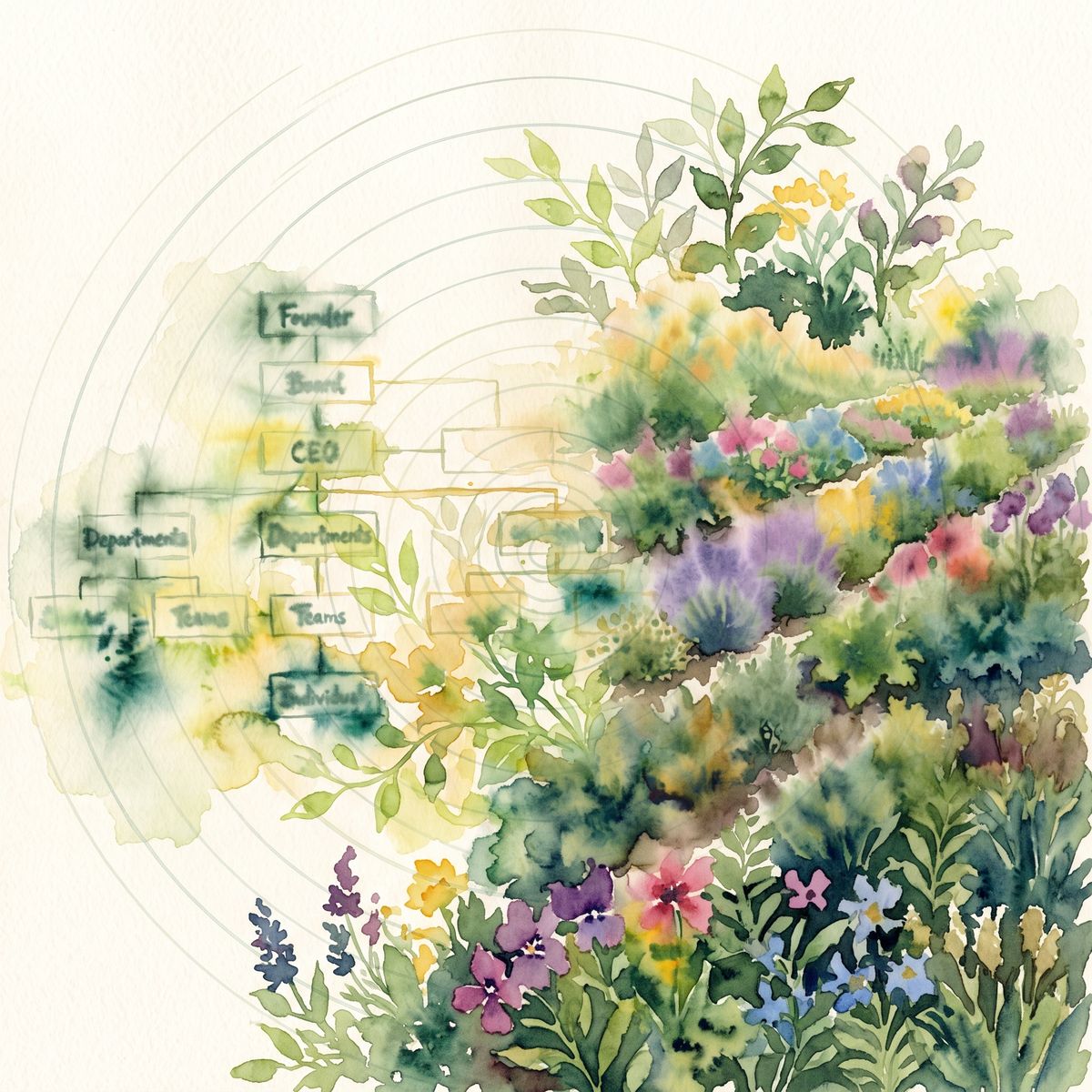
Many of the ways we talk about organizations borrow from machines. We speak of levers, inputs and outputs, and of fixing what’s broken. Organization charts show boxes and lines. Those views are useful: structure matters, and some problems really are mechanical.
But much of organizational life doesn’t behave like a machine. A change in one place shows up somewhere else. People respond to how they are treated, not only to what they are told. Habits form, spread and persist. An ecosystem perspective adds a lens for seeing those interactions.
Why this perspective matters
When leaders look at an organization as an ecosystem, a few things come into focus that are easy to miss otherwise.
Problems rarely exist in isolation
Missed handoffs between two teams can look like a process problem. Look closer and they may trace back to unclear priorities, a reporting structure that keeps the teams apart, or a strained relationship between their leaders.
Changing one part affects other parts
A new performance measure changes what people pay attention to. If it rewards individual results, collaboration may quietly decline, even though no one intended that.
Relationships and systems shape each other
A new system changes who needs to talk to whom. At the same time, the level of trust between people affects whether they use a system honestly or work around it.
Culture grows from many sources
Culture can’t simply be announced. It grows out of structures, incentives, expectations and the everyday behavior of leaders, and it changes when those change.
The environment matters
Funding, markets, communities, regulations and wider events all shape what is possible inside an organization. A strategy that ignores the environment is working with an incomplete picture.
The elements of an organizational ecosystem
These are the elements IntoWisdom pays attention to. None of them stands alone: each one shapes, and is shaped by, the others.
- People The individuals who do the work, with their skills, needs, energy and aspirations.
- Relationships How people connect: trust, communication, collaboration and tension.
- Culture The shared habits, assumptions and expectations about how things are done.
- Structures Roles, reporting lines, teams and how decisions are made.
- Systems Processes, tools, measures and the ways information and work move.
- Resources Time, money, attention, knowledge and the capacity to act.
- Environment Everything outside the organization that shapes it: markets, communities, funders, regulations and wider events.
The overlaps matter as much as the elements themselves. Most of the interesting questions in an organization live where two or more of them meet.
A different way to look at organizational problems
An ecosystem perspective doesn’t replace practical questions. It adds questions that help leaders see what is producing the results they’re getting.
- Instead of only asking, “Who is causing the problem?” also ask, “What interactions are producing this result?”
- Instead of only asking, “What process should we fix?” also ask, “How does this process interact with people, relationships, expectations and the world around us?”
- Instead of only asking, “Why won’t people change?” also ask, “What in their environment makes the current way of working make sense to them?”
- Instead of only asking, “What’s the best practice?” also ask, “What would work here, given our people, culture and resources?”
- Instead of only asking, “How do we roll this out?” also ask, “Where could we try this first, and what would we learn from it?”
The second question in each pair doesn’t excuse anyone from responsibility. It widens the view, so the action that follows is more likely to help.
From insight to action
Seeing an organization as an ecosystem is not a reason to avoid action. It’s a way to make better-informed choices about where and how to act, then learn from what happens.
- Understand Look at what’s happening across the system, not only at the symptom.
- Define Success Agree on what a healthier result would look like and how you’ll notice it.
- Explore Look for the interactions involved and the practical places where change could begin.
- Decide Choose a next best step, often a small one you can learn from.
- Act Make the change, and pay attention to how other parts respond.
- Learn Reflect, adjust and decide what comes next.
Because the parts of an ecosystem keep responding to one another, the work continues as a cycle: act, notice, learn and adjust.
What this looks like in practice
Here is how the ecosystem perspective shows up in different kinds of IntoWisdom work. These are illustrations of the approach, not accounts of particular clients.
In leadership development
A leader’s behavior affects relationships, expectations, communication and, over time, culture. Leadership development looks at those ripple effects, not only at individual skills.
In organizational development
A structural or process change will affect behavior, relationships and culture. The work looks at those effects before and after the change, not only at the new design.
In facilitation
A facilitated conversation can surface interactions and perspectives that are hard to see from inside one part of an organization.
In strategic action
A strategy needs to account for the organization’s capacity, relationships, systems, resources and environment, or it stays on paper.
Where this idea connects to IntoWisdom’s work
The ecosystem perspective runs through IntoWisdom’s services, most directly these three.
Service
Organizational Development
Helping organizations understand how people, culture, systems and work affect one another, and act on it.
Service
Leadership Development
Building leadership capability with attention to its effects on relationships and culture.
Service
Facilitation
Conversations that help groups see the wider system and decide together.
From the IntoWisdom library
Articles, tools, events and resources connected to Organizations as Ecosystems.
Workshop · Available on request
The Strategic Plan That Survives Monday Morning
A program customized to your needs. This practical workshop that results in a actionable strategic plan for your organizations.
Event details: The Strategic Plan That Survives Monday Morning
Article
Nobody Should Be Surprised in a Performance Review
Performance Reviews are stressful for the performer and the Manager. The traditional process tends to decrease perveance rather than improve it. lt probably isn't…
Read article: Nobody Should Be Surprised in a Performance Review