
How thinking like a gardener — not a general — changes what’s possible for the people you lead

You’ve probably felt it. The meeting where half the room is physically present and mentally elsewhere. The team member who does exactly what’s asked and nothing more. The performance review where everything looks fine on paper but something is clearly missing.
You’re not imagining it. If you spend any time reading about leadership and workplace culture, you’ve seen the headlines:
“Only 31% of U.S. employees are engaged.”
“79% of workers are disengaged.”
“Most employees are mentally checked out.”
Gallup has been tracking this for years, and the numbers are remarkably consistent. Most people at work are not fully invested. They show up. They meet expectations. They put in the hours. But the energy, the initiative, the genuine enthusiasm that makes a team feel alive — that part is mostly absent.
And the story these headlines tell is the same every time: something is wrong with the workforce. People have stopped caring. Employees are the problem.
But what if that framing is wrong? What if the engagement crisis isn’t a story about employees who have checked out — but about conditions that make checking out the most rational response available to them?
What if the problem isn’t your people?
Checked Out — or Just Being Rational?
Gallup defines disengaged employees as people who complete their responsibilities and meet expectations — but are fueled by obligation rather than enthusiasm. They do the job. They just don’t do the extra.
And then we call them checked out, as if something is wrong with them.

Here’s a question worth sitting with: if someone on your team consistently meets their performance expectations, is it fair to say they’re failing? Or are they doing exactly what their role, their compensation, and their working conditions justify — while reasonably withholding the discretionary effort that was never formally part of the agreement?
Because that’s what this conversation is about. When we label reliable, competent people as “not engaged,” we’re making a quiet assumption — that enthusiasm, initiative, and emotional investment should come standard, at no additional cost to the organization, regardless of what the organization has done to earn them.
That’s not a performance problem. That’s an imbalance.
And the people on your team can feel it, even when they can’t name it.
Engagement Isn’t a Trait. It’s a Response.
I’ve spent years working inside organizations as an organizational development consultant — sitting with leadership teams, running facilitation sessions, trying to help people figure out why their engagement numbers keep coming back disappointing despite genuine effort to improve them.
The answer is almost never the people.
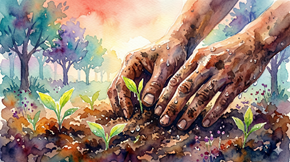
What I’ve come to believe — and what I’ve watched play out in organization after organization — is that engagement isn’t a quality your employees either have or lack. It’s a response to the environment you create. It’s what happens, or doesn’t, depending on the conditions people are working in.
Think about it this way. In any managed ecosystem — a farm, a garden, a carefully tended orchard — thriving depends entirely on stewardship. The conditions determine the yield.
Imagine a farmer who decides his tomato plants aren’t pulling their weight. Yields are down. Engagement scores — if tomatoes had engagement scores — would be dismal. So he walks out to the garden, crouches down in front of a struggling plant, and explains, firmly but fairly, that the organization has high expectations. That fruiting is not optional. That if the plant cannot demonstrate greater initiative and discretionary effort by the end of the quarter, there will be consequences. He leaves a strongly worded note. He schedules a follow-up.
The tomato plant does not fruit.
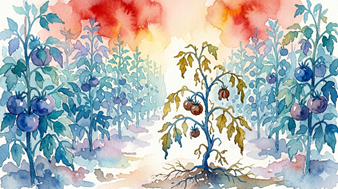
This is, more or less, what we do with people.
You cannot demand a tomato plant to want to bear fruit. What you can do — what you must do, if you want a real harvest — is create the conditions where fruiting is natural, sustainable, and the obvious thing for a healthy plant to do. Rich soil. Consistent water. The right light. Protection from what would harm it. Get those conditions right and the plant does not need to be motivated. It fruits because that’s what healthy plants in good conditions do.
Your team works the same way.
When the right conditions exist — genuine trust, clarity about what’s expected, real support, fair exchange, and space for people to do what they do best — engagement arises on its own. You don’t have to manufacture it, incentivize it, or measure it into existence.
And when those conditions are absent? People do what any organism does in a depleted environment.
They conserve resources. They survive.
That’s not failure. That’s adaptation.
The Leader as Gardener
Most of us were handed leadership models built on one of two metaphors. The general commands and controls — directs, deploys, disciplines. The mechanic identifies broken parts and fixes them. Both assume your job is to act upon your people.
But in a living system — and a team is a living system — that approach produces compliance. Not engagement. Compliance.

The leaders I’ve watched build genuinely invested, high-performing teams think more like gardeners.
A farmer cannot pull on seedlings to make them grow faster. Gripping the stem and yanking upward doesn’t accelerate growth — it destroys it. The farmer can only tend the conditions: the soil, the water, the light, the protection from what would harm the crop. Leadership works the same way. You cannot order someone into genuine commitment. You can only build the environment where commitment becomes the natural response.
Skilled gardeners also watch closely. Are the leaves yellowing? Is the soil too dry? Are there early signs of something going wrong before it becomes a crisis? They don’t wait for the harvest to fail before they pay attention. They observe continuously and adjust based on what they see — changing the conditions rather than blaming the plants.
Effective leaders do the same. Where is energy low on your team? Where are people quietly stepping back? What changed in the environment that might explain what you’re seeing? The gardener-leader looks at the soil before they look at the crop.
And perhaps most importantly, a farmer who strips the land bare for one exceptional harvest will face poor yields for seasons to come. The soil must be replenished. A leader who extracts maximum effort without investing in the conditions that make that effort possible will eventually face the same result: burnout, turnover, and the slow erosion of the trust that makes discretionary effort possible in the first place.
Sustainable performance requires stewardship. Not extraction.
The Conversation Most Leaders Haven’t Had
Here’s what bothers me most about how the engagement conversation usually goes within organizations.
We label people as not engaged when they’re doing their job without extra passion — as if passion were a contractual obligation rather than a response to conditions. We treat discretionary effort as a baseline expectation rather than something that must be genuinely invited, recognized, and rewarded. And when the numbers come back disappointing, we look at the people rather than the environment we’ve built for them.
Gallup’s own research — the same research that produces the troubling engagement statistics — consistently shows that engagement is tied to clear expectations, adequate resources, opportunities to do meaningful work, recognition, and managers who genuinely care about the people on their team. When those conditions are missing, and people are still labeled as the problem, we’ve done something unfair. We’ve shifted responsibility from the system that created the conditions onto the individuals living within them.
I’ve sat in rooms with leaders who are genuinely troubled by their engagement numbers and genuinely convinced the solution is a better communication campaign, a new survey, or a refreshed recognition program. Sometimes those things help at the margins. But they don’t address the soil. They’re the organizational equivalent of leaving a strongly worded note for the tomato plant — busy, well-intentioned, and aimed at entirely the wrong thing.
The foundation is the conditions. And the conditions are your responsibility.

What This Actually Looks Like
The shift from general to gardener isn’t a philosophy. It’s a set of daily questions you ask yourself about the people you lead.
Not: why aren’t they more motivated?
But what conditions am I creating? Where is the imbalance between what I’m asking of my people and what I’m giving back? Am I tending this team — watching for early signs, replenishing what I harvest, protecting people from what would harm them — or am I simply extracting performance and wondering why the yields keep declining?
And perhaps most importantly: is the extra effort I’m hoping for something people genuinely choose to give, because they feel seen and valued and fairly treated? Or is it an unpaid expectation I’ve quietly built into the floor of what I consider acceptable?
Engagement, at its best, is a shared responsibility. Your people bring competence, integrity, and reliable performance. Your job — the part most leadership models don’t talk about — is to cultivate the conditions that make enthusiasm and genuine commitment possible. Not by demanding them. By earning them.
The way a skilled gardener earns a harvest. Not by forcing growth. By tending to what makes growth possible.
Before Your Next Conversation About Engagement
Stop asking why your people aren’t more invested.
Start asking what kind of environment you’ve built — and whether it’s genuinely the kind of place where a person with options would choose to bring their best.
Because here’s what I’ve watched happen, in team after team, when a leader makes that shift. When the trust is real, and the expectations are clear, and the exchange is fair — when people feel seen and supported and genuinely valued for what they contribute — you don’t have to chase engagement.
It grows.
And so does everything else.

A Note on Where This Idea Came From
I’ve been thinking about organizations as managed ecosystems for a while now. The framework didn’t start in a consulting room — it started in an apple orchard, watching my grandfather tend trees that had been producing for decades because he understood exactly what they needed and never once thought about demanding it of them.
If you want to trace this idea back to where it began, these two pieces from 2023 are where I first worked it out:
Farming — The Most Important Leadership Competency — where I first made the case that organizations work like managed ecosystems and that tending the system is the leader’s most essential job.
The Essential Leadership Skill: How My Grandfather, the Apple Farmer, Trained Me to Lead — where the idea got its roots, and where my grandfather’s orchard became the lens through which I’ve thought about leadership ever since.
The tomato plant in this article owes a considerable debt to those apple trees.
John Losey is an organizational ecologist, facilitator trainer, and founder of the Facilitators’ Guild and IntoWisdom Group. He works with leaders and organizations to build the conditions where people and teams can do their best work.
© 2026 The IntoWisdom Group. This article is part of an ongoing series on facilitation, leadership, and organizational life.
(AI was used in this article for research, grammar, and feedback. All content is the work of the author. The author has significantly edited any contributions from AI.)
(Images by ChatGPT, Gemini, and John Losey)