

Walk into any corporate training room and you’ll often find someone reviewing a leadership assessment report, perhaps a DiSC© profile, StrengthsFinder©, or the results from the latest 360-degree feedback tool. As a consultant and coach, I’ve been trained in and use several different leadership assessments. It’s one of the first questions many clients ask: “What assessment do you use?” These assessments have become fixtures in talent development, coaching sessions, and hiring decisions across virtually every industry.
Yet here’s the misconception that costs organizations millions in unrealized potential: the belief that an assessment’s primary value lies in its scores, percentiles, or final report. That’s like believing a map’s value is in the paper it’s printed on, rather than the journey it enables.
Leadership is a profoundly human phenomenon, messy, contextual, and constantly evolving. It cannot be captured completely by any standardized measurement, no matter how rigorously validated. The true power of leadership assessments is unlocked not in their data points but through dialogue. The conversations sparked by the assessment transform static numbers into dynamic self-awareness, meaningful growth, and organizational alignment.
The Limits of Data Alone — Why Scores Don’t Tell the Whole Story

Assessments as Approximations, Not Absolutes
Consider the challenge of measuring empathy or influence, qualities that define exceptional leaders yet resist simple quantification. Leadership assessments distill these complex, subjective capabilities into standardized scores through what we might call “purposeful approximation.” They simplify reality to enable analysis, but they cannot erase the richness of lived experience.
A leader might score moderately on assertiveness, but that number doesn’t capture how they navigate conflict with a struggling team member, or how their quiet confidence inspires trust during a crisis. These numbers are powerful inputs for discussion, not standalone verdicts about someone’s leadership potential.
The Challenge of Measuring a Dynamic Target
Leadership isn’t a fixed trait, it is highly contextual, shifting with team dynamics, organizational culture, and situational pressures. The executive who thrives in a startup’s fast-paced environment might struggle in a traditional corporate hierarchy. The manager who excels with experienced professionals might face challenges leading recent graduates.
This complexity means assessment results should offer probabilistic guidance and areas for exploration rather than absolute certainty. They point toward tendencies and preferences, not guarantees of future performance. Organizations that treat assessment scores as definitive predictors often find themselves disappointed when real-world leadership looks different than what the numbers suggested.

The “Objectivity Paradox”
Tools like the Caliper Profile or Birkman Method strive for objectivity through rigorous validation and normative data. Yet the moment we interpret and apply that data, we reintroduce human judgment, and that’s exactly as it should be. The goal isn’t to eliminate the human element but to use these tools as a bridge, not a boundary, opening pathways for deeper exploration rather than closing off possibilities.
Tale of Two Approaches: Data vs. Dialogue
The Data-Only Approach:
Maria, a regional sales director, receives her leadership assessment results in a brief email from HR. The report shows she scores high in results orientation but low in team collaboration. Her manager mentions it in passing during their next one-on-one: “You might want to work on being more collaborative.” Maria files the report away, feeling labeled rather than enlightened.
Six months later, her team turnover remains high, and she’s no closer to understanding why her direct approach creates distance with her team. The assessment identified a pattern but provided no pathway for change.
The Conversation-Driven Approach:
Maria receives the same results, but this time through a structured dialogue with a skilled coach. Together, they explore what “results orientation” looks like in practice. Maria realizes her urgency often translates to interrupting others during meetings. Her “low collaboration” score makes sense when she reflects on how she makes decisions quickly, then communicates them as final, rather than seeking input.
Through ongoing conversations, Maria practices new behaviors, such as asking team members for their perspective before sharing her own, scheduling decision-making meetings separately from information-gathering sessions, and following up individually with quieter team members. The same data, processed through dialogue, becomes a roadmap for transformation.
The difference? Time investment of perhaps two additional hours over three months yields a leader who retains talent, builds trust, and delivers better results through her team.

The Conversation as a Catalyst for Transformation
From Mirror to Meaning
Think of assessments as powerful mirrors and maps. The mirror reflects current capabilities, tendencies, and blind spots. The map charts potential pathways for growth and development. But neither the mirror nor the map creates change by itself.
The conversation is the process that helps leaders make sense of their reflection. It’s where they explore what the data means within their unique context, connecting abstract metrics to personal stories, team dynamics, and organizational realities. A score indicating “low tolerance for ambiguity” becomes meaningful when discussed in light of a leader’s struggles during a recent merger or their discomfort with the company’s shift to remote work.
Uncovering Blind Spots and Fostering Self-Awareness
We all carry blind spots — patterns of behavior or impact that remain invisible to us but obvious to others. Dialogue provides the safe space needed to challenge assumptions and explore these hidden areas. When a leader discovers through conversation that their “results orientation” sometimes comes across as impatience or dismissiveness, they gain insight that no report alone could provide.
This enhanced self-awareness becomes the foundation for genuine growth. It shifts leaders from defending their current approach to owning their development, creating the psychological safety needed for behavioral change.
The ROI of Conversation: Addressing Time Investment Concerns
“This sounds time-intensive. Do we really have bandwidth for extended coaching conversations?” This objection surfaces regularly when organizations consider deeper assessment follow-through.
The reality: Organizations already invest significantly in leadership assessments, often $200–500 per person for quality tools, plus administrative time. The incremental investment in structured conversations typically adds 2–4 hours over 2–3 months. Compare this to the cost of leadership turnover (often 200–300% of annual salary), failed promotions, or teams operating below potential.
More importantly, this approach is scalable. HR professionals and internal coaches can be trained to facilitate these conversations. The investment in developing this capability pays dividends across every future assessment.
Practical Conversation Framework: FACT-Based™ Performance Coaching*
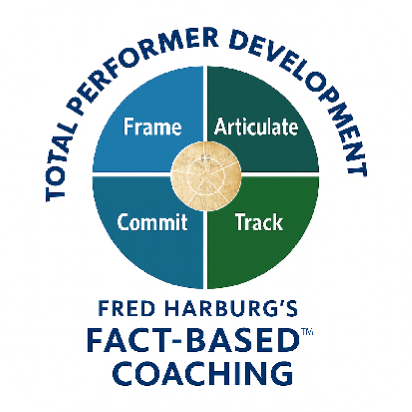
F — Frame the Context: Establish understanding of assessment results within the leader’s reality
- “What do you see as the most important insights from these assessments?”
- “What would it look like to successfully implement these insights?”
- “Which findings align with your self-perception?”
- “How do these insights connect to the challenges you’re currently facing?”
A — Articulate and Assess Alternatives: Explore multiple pathways and their implications
- “What ideas do you have to implement these insights?”
- “Who do you know that does these things well? What do they do?”
- “What are different ways you could approach this development area?”
- “What one or two of these ideas do you think you could implement right away?”
C — Commit to Action: Create specific, observable behavioral commitments
- “What’s one behavior you could practice consistently over the next 30 days?”
- “How will you know you’re making progress?”
- “When will you start?”
- “What would success look like to both you and your team?”
- “How will we measure the impact of these behavioral shifts?”
T — Track Progress: Establish ongoing accountability and measurement systems
- “When should we check in on your progress?”
- “Who else could provide you feedback on these changes?”
- “What support do you need to maintain this focus?”
This FACT-Based™ approach ensures that assessment insights translate into concrete actions with measurable outcomes. Rather than general development discussions, it creates a structured pathway from data interpretation to behavioral change to performance improvement.
Building a Development Journey, Not a One-Time Debrief
The Risk of the “One-and-Done” Meeting
Picture this scenario: A leader receives their assessment results in a 90-minute meeting, discusses the highlights, identifies a few areas for improvement, and files the report away. Three months later, they can barely remember their scores, let alone whether they’ve made progress on their development goals.
This “one-and-done” approach is a costly missed opportunity. It leads to surface-level understanding, oversimplification of complex behavioral patterns, and zero accountability for change. Most importantly, it ignores how real behavioral development actually works.

From Report to Roadmap
True behavioral change requires iterative cycles of assessment, reflection, action, and feedback. The initial assessment should launch a coaching curriculum, not conclude it. This approach allows for targeted development plans, provides benchmarks to measure progress, and creates the sustained support needed for lasting change.
The 90-Day Development Sprint Framework
Week 1–2: Foundation Setting
- Comprehensive debrief using FACT-Based™ Performance Coaching
- Identify 1–2 specific development goals
- Create observable behavior indicators
Month 1: Awareness Building
- Weekly self-reflection check-ins (Tracking)
- Gather informal feedback from key stakeholders
- Practice new behaviors in low-risk situations
Month 2: Skill Application
- Apply new approaches in higher-stakes situations
- Mid-point coaching conversation to adjust course
- Document successes and challenges
Month 3: Integration & Planning
- Final assessment of progress
- Plan for sustained development beyond the sprint
- Set longer-term growth objectives
This framework provides structure while remaining flexible enough for different organizational contexts and individual needs.
Scaling the Conversation for Organizational Impact
Creating Shared Understanding and Alignment
When assessment conversations happen across teams or leadership cohorts, they create something powerful: a common language for development. Teams begin using shared vocabulary to discuss strengths, address challenges, and set expectations. This transparency builds trust and helps diverse personalities understand how to work together more effectively.
Imagine a leadership team where everyone understands that Sarah needs processing time before making decisions, that Marcus thrives on frequent feedback, and that Jennifer’s direct communication style reflects efficiency, not disrespect. These insights, drawn from assessment conversations, transform team dynamics.
Informing Strategic Talent Decisions
This conversation-based approach makes critical processes, such as succession planning, more strategic and less speculative. Rather than relying solely on assessment scores or “9-Boxes” to identify high-potential leaders, organizations gain predictive insight by combining objective data with a nuanced understanding of each individual’s growth trajectory, motivations, and contextual factors.
The result is better talent, promotions based on genuine readiness rather than impressive test scores, development investments targeted toward actual growth potential, and succession plans that account for both capability and cultural fit.
Implementation Roadmap for Organizations
Phase 1: Build Internal Capability (Months 1–2)
- Agree upon an assessment strategy and train HR professionals to administer the assessment.
- Train HR professionals and all people managers in conversation facilitation*
- Pilot with willing participants
Phase 2: Systematic Rollout (Months 3–6)
- Integrate conversation requirements into assessment processes
- Track advancement, engagement, and satisfaction metrics
- Refine approach based on early feedback
Phase 3: Culture Integration (Months 6–12)
- Make ongoing development conversations standard practice
- Measure impact on promotions, retention, engagement, and performance
- Scale successful approaches across the organization

Your Leadership Story Is Written in Dialogue, Not Data
Leadership assessments are essential tools in the modern organization’s development toolkit. They provide valuable data, reveal important patterns, and create starting points for growth. But they are not the answer, they are the beginning of the question.
Their potential is realized only when paired with skilled interpretation and ongoing coaching. The real engine of growth is not the report sitting in someone’s desk drawer, but the human connection, reflection, and dialogue that brings it to life.
The numbers matter. The conversation matters more.
For organizations seeking resilience and sustainability, leaders seeking to maximize their development, HR professionals designing talent strategies, and coaches guiding others’ growth, the investment in conversation-driven assessment follow-through pays dividends that compound over time. What begins as an additional two hours of dialogue becomes a leadership transformation that impacts teams, results, and organizational culture.
Your leadership story isn’t written in percentiles and scores. It’s written in the moments when you pause to reflect, the courage to acknowledge blind spots, and the commitment to change. The assessment simply provides the opening line, but the conversation writes the chapters that follow.
*Check out the Introduction to FACT-Based™ Performance Coaching Workshop to train your people in a practical model they can implement immediately for assessment and other development interactions. Turn every
conversation into development.
(All images by Adobe Stock, and John Losey)
(AI was used in this article for research, grammar, and feedback. All content is the work of the author. The author has significantly edited any contributions from AI.)
This article first appeared on Medium.