

The leadership distinction between data-driven and data-informed — and how to know when you’ve crossed the line

A question many leaders bring to me is “Why do metrics stop working when they become targets?”
It seems that as soon as a metric is created, people learn how to “game” it.
That’s not cynicism. That’s not a reason to stop measuring. It’s a pattern so reliable, so consistent across industries, decades, and organizational types, that ignoring it is its own kind of leadership failure no dashboard will flag.
Here’s what it looks like in practice.
A large insurance company had a problem: file quality scores were dropping. Leadership responded the way leaders are trained to respond — they brought in a solution. A Total Quality Management (TQM) system. New protocols. Clear metrics. Accountability structures. Within a few months, the scores went up.
The actual quality of the files went down.
Employees had learned — quickly, efficiently, without any malicious intent — how to produce scores that satisfied the system without producing the work the system was supposed to measure. Their compensation and promotions depended on their scores. Their files were built to satisfy the measurements. Their estimates and evaluations didn’t reflect reality. Their customer contact timelines were based on the requirements, not the customers’ needs. Claims were paid out that shouldn’t have been. Customer service deteriorated. The metric said everything was fine. The business said otherwise.
This is the trap. And most of us already know it’s there.
The Distinction Nobody Actually Makes

There’s a difference between being data-driven and being data-informed, and it matters more than the language suggests.
Data-driven means the number makes the decision. You hit it, you proceed. You miss it, you don’t. The metric is no longer the measure; it’s the verdict.
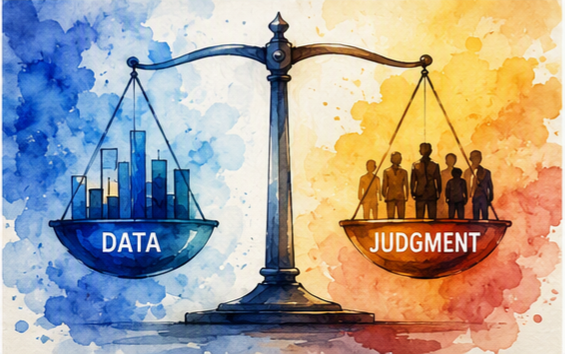
Data-informed means the number starts the conversation. You look at what it’s telling you, you look at what it’s not telling you, and then you decide. The metric is the input. Your judgment is the verdict.
Allowing information to inform our decisions and judgment, rather than becoming a slave to the numbers.
Why It Keeps Happening
Most organizational metrics begin as an honest attempt to turn a judgment call into something scalable.
Judgment doesn’t scale. A senior leader can assess the quality of ten files in a way that accounts for context, nuance, and the things that don’t show up in a checklist. They know what quality looks like. That same leader cannot assess ten thousand files the same way. So, they build a system. The system produces numbers. The numbers travel up the organization faster and more reliably than the judgment ever could.
And somewhere in that process, quietly, without anyone making a conscious decision, the number replaces the judgment rather than informing it.
There’s a reason this has been happening for longer than any of us have been working. In Soviet-era factories, production quotas were measured by the number of nails produced. Factories optimized for the quota. They made enormous quantities of tiny, useless nails — or, when quotas shifted to weight, a small number of enormous, useless ones. The measurement was accurate. The output was absurd. The people running those factories weren’t foolish. They were rational. They were doing exactly what the system asked of them.
The system was asking for the wrong thing.
The Easy-to-Measure Trap
Here’s the part that’s harder to admit: we often don’t even pick the wrong metric on purpose. We pick it because it’s the one we can actually measure.
Some information is so difficult to collect and objectify that we end up selecting the data that’s easiest to gather, rather than the data that tells us what we need to know.
Think about screen time limits for children. Easy to monitor: total minutes. Nearly impossible to monitor: whether those minutes built something or broke it down. So, we measure the minutes. We set limits on the minutes. We call it a policy. And we tell ourselves we’ve addressed the problem.
The Gaming Problem
Once a measurement becomes a target, it stops being an honest measurement.
This is sometimes called Goodhart’s Law or Campbell’s Law. In the insurance company, it took a few months — not years — for people to figure out how to satisfy the TQM scores without improving the underlying files. Nobody had to conspire. Nobody had to be dishonest. They just responded rationally to the incentives in front of them.
This is the mechanism: whatever you measure, someone downstream will optimize for the measurement itself rather than the thing the measurement was meant to track. It happens in well-run organizations with good people. It happens to leaders who know exactly what I’m describing right now and still don’t catch it in their own systems until the real-world consequences — the paid claims, the lost customers, the eroded product quality — make the gap impossible to ignore.
Knowing the trap exists doesn’t make you immune to it. That’s the uncomfortable part.
Goodhart describes what happens to the metric, Campbell describes what happens to the organization, and McNamara describes what happens to the leader who stops questioning both.
Together, they have been naming the same trap for fifty years — in monetary policy, in social programs, in wartime strategy. It shows up in your performance review cycle for the same reason it showed up in a Soviet nail factory: the system was asking for the wrong thing.
The most personal version of this failure happens in the performance review cycle, where the stakes aren’t claims paid out, or customers lost. The stakes are their livelihood — their careers.
When the Trap Has a Human Face
Here’s a scenario that plays out in organizations every day, in every industry, at every level of leadership. A high performer — someone whose work is genuinely excellent, whose clients trust them, whose team relies on them, who has been carrying more than their share for two years — comes up for promotion. The review committee looks at the numbers. The composite score lands at 3.9 on a 4.0 scale. The threshold for promotion is 4.0.
They don’t get the promotion.
Not because anyone in that room believes they don’t deserve it. Not because the manager who knows their work thinks the score reflects their contribution. But because the system says 3.9, and the system’s threshold is 4.0, and somewhere along the way the organization decided that consistency and objectivity meant treating the number as the verdict rather than the starting point.
The research confirms what the people in that room already know: 51% of workers believe their annual reviews contain biases or show inaccurate information, and 87% of staff members who receive an unexpected evaluation rating show a 23% decrease in their engagement levels.
A 0.1-point gap on a composite score is not a performance gap. It is a measurement gap. The organization just used it as if they were the same thing.
The high performer learns something true about the organization: that what the system measures matters more than how they perform. The manager who knows the score is wrong learns something too — that their judgment is subordinate to the rubric. The team watching the decision learns it fastest of all. They adjust their behavior accordingly. Not maliciously. Rationally. They ignore performance and start working for the score.
You have just done, in the performance review cycle, exactly what the insurance company did with its TQM system. You created a metric to measure something that matters. People learned what the metric rewards. The metric and the thing it measures slowly separated. And the person who paid the price wasn’t an abstract cost center. It was a valued employee who showed up every day, did real work, and trusted that the system would see it.
This is where data-driven leadership stops being an operational problem and becomes a leadership character problem. The operational failure is real: you may lose that person, and you will almost certainly change their relationship to the work. But the deeper failure is that you had the information required to make the right call — your own knowledge of this person’s contribution, your manager’s direct assessment, two years of observed performance — and you chose the number instead.
Not because the number was right. Because the number was easier to defend.
How to Know When You’ve Crossed the Line
This is where most leadership advice stops short — offering principles like “stay curious” and “question your metrics.” Sound guidance. Difficult to execute on a Monday morning.
Here are the specific signals that you’ve already crossed from data-informed to data-driven — that the spreadsheet has quietly become the boss.
You’ve stopped asking why the number looks the way it does.
You used to ask. You’d see a metric move and want to understand the mechanism. Now you see the number, note whether it’s trending in the right direction, and move on. The number has become a verdict rather than a question.
You can’t remember what the metric was originally trying to measure.
Every metric started as a proxy for something real. File quality scores were supposed to represent actual file quality. A performance rating was supposed to represent actual performance. When the proxy and the thing it was measuring have drifted apart, you can usually feel it — if you stop to feel it. If you’ve forgotten to ask whether they’re still aligned, you’ve stopped leading the measurement. It’s leading you.
Your team has gotten better at the metric without getting better at the work.
This is the clearest signal of all, and the hardest to face. When scores go up and real-world results go sideways — when TQM numbers climb and claims payouts rise, when performance ratings normalize and your best people stop raising their hands — the measurement and the mission have separated. Closing that gap is leadership work. Ignoring it is abdication.
You’ve made a decision you knew was wrong because the number said so.
This is the performance review signal. If you’ve sat in a review meeting and watched a strong performer get passed over because their composite score missed a threshold by a fraction — and you said nothing, or said something and were overruled, and the decision stood because the system required it — you have located the exact place where your organization crossed the line. The question isn’t whether the metric was wrong. It’s whether anyone in that room had the authority and the courage to say so.
You feel uncomfortable when someone questions the number.
A leader who is genuinely data-informed welcomes the question what isn’t this telling us? A leader who has become data-driven experiences that question as a threat. If the metric has become the thing you defend rather than the thing you interrogate, the spreadsheet is already running the meeting.
The Way Out
Keep measuring. Seriously, don’t throw out the data. The answer to Goodhart’s Law is not to stop measuring. It’s to stay in charge of your own judgment.
The shift is in posture, not in process.
Before you act on a number, ask what it isn’t telling you. This sounds simple. It is simple. It’s also the question data-driven leadership has trained most of us to skip — because the number feels complete, like the end of the analysis. Treating it as the beginning of a conversation requires a discipline that runs against the efficiency impulse most leaders spend their careers developing.
In a performance review, this question has a specific form: does the score match what I know about this person’s actual contribution? If the answer is no — if you can feel the gap between the number and the work — that gap is not a rounding error. It is the signal that your measurement system needs you to exercise your judgment, not defer to it.
Use your judgment. That’s what it’s for.
The practical path back is to run a metric audit, not on the data, but on the relationship between the measurement and the thing it was meant to measure. Ask your team: what is this metric capturing well, and what is it missing? Ask it with genuine curiosity. The people closest to the work almost always know where the gap is. They’ve usually known for a while. They’ve been waiting for someone to ask.
Your high performers know where the gaps are. The question is whether you ask before you lose them to an organization that will.
The Honest Admission
Almost all of us already know we shouldn’t become slaves to the numbers. We’ve read the case studies. We’ve nodded along to this exact argument before.
And it still happens. To good leaders. In well-run organizations. In the middle of performance cycles that were designed specifically to be fair.
It happens because measurement feels objective, and objectivity is easy to defend. Judgment is uncomfortable. Organizations under pressure migrate toward whatever is most comfortable to defend in a quarterly review or a promotion committee meeting.
The discipline of data-informed leadership isn’t about knowing better. It’s about building the specific habits — the why is this number moving question, the what is this missing question, the regular audit of whether the measurement still reflects the mission, and the is the measure still needed question. These questions interrupt the slide before the real-world consequences arrive.
Sometimes those consequences show up in a balance sheet. Sometimes they show up in the turnover of your best people.
Both are real. The second one is harder to undo.
The spreadsheet is a tool. You are the leader. Keep it that way.
Don’t be a slave to the numbers.
Are you curious?
The McNamara Fallacy · Goodhart’s Law · Campbell’s Law

John Losey is an organizational ecologist, facilitator trainer, and founder of the Facilitators’ Guild and IntoWisdom Group. He works with leaders and organizations to build the conditions where people and teams can do their best work.
© 2026 The IntoWisdom Group. This article is part of an ongoing series on facilitation, leadership, and organizational life.
(AI was used in this article for research, grammar, and feedback. All content is the work of the author. The author has significantly edited any contributions from AI. The insurance company experience, the analysis, the voice, and all substantive conclusions are the author’s own.)
(Images by ChatGPT)
This article first appeared on Medium.