
“We need better leadership!”
“Our sales team just isn’t hitting their marks!” “
Our customer service is tanking! We need to skill up our people.”
Sound familiar? You’ve heard these pleas before, but are you truly solving the problem, or just slapping a band-aid on a gaping wound? It’s time to admit that stand-alone training events are failing us.
As someone who has been in corporate learning for a few decades, I’ve often heard requests like these. The typical solution is to design and deliver a training event, an in-person program or conference to be rolled out ASAP. A multi-day class or even a week-long conference would create an opportunity for everyone to get on the same page and develop the skills needed for success. But does this really happen?
Why “Stand-Alone” Learning Doesn’t Work
Stand-alone learning events seldom create significant change or lasting impact. (Promethean, 2023) These classes or conferences can develop connections and build community, rarely resulting in the desired learning or behavior changes outlined in their objectives. Relationship building and team bonding are worthy outcomes in themselves, but do not result in improved technical or professional competencies.
“These classes or conferences can develop connections and build community, rarely resulting in the desired learning or behavior changes outlined in their objectives.”
Event-based training doesn’t allow people the time needed for concepts to sink in or skills to be developed through guided practice (National Library of Medicine, 2021). They also limit the variety of learning experiences that could be applied to attaining the desired results. By understanding the Organizational Learning Ecosystem Model and the power of Longitudinal Learning (Spaced Learning- learning distributed over time and space), your training programs will be more accurate at hitting your desired outcomes and become more cost-effective.
Organizational Learning Ecosystem
Not every learning context is equal. Different approaches work better for different outcomes. In-person Learning experiences can also be maximized by knowing what programs work best for the desired outcomes and audiences.
Many organizations see in-person programs as the best approach to learning. Having everyone in the same place at the same time creates a practical context for skill development and feedback. It’s also the most expensive time and, arguably, less effective (Harvard, 2020). Too often, we spend the time together on information transfer instead of creating interactive and engaging experiences that change behaviors and improve skill application.
Moving everything online isn’t the answer either. While introducing concepts and language work well in e-learning courses, and discussions and exploration can happen in the virtual context, skill building, competency development, and guided practice work best in an in-person context.
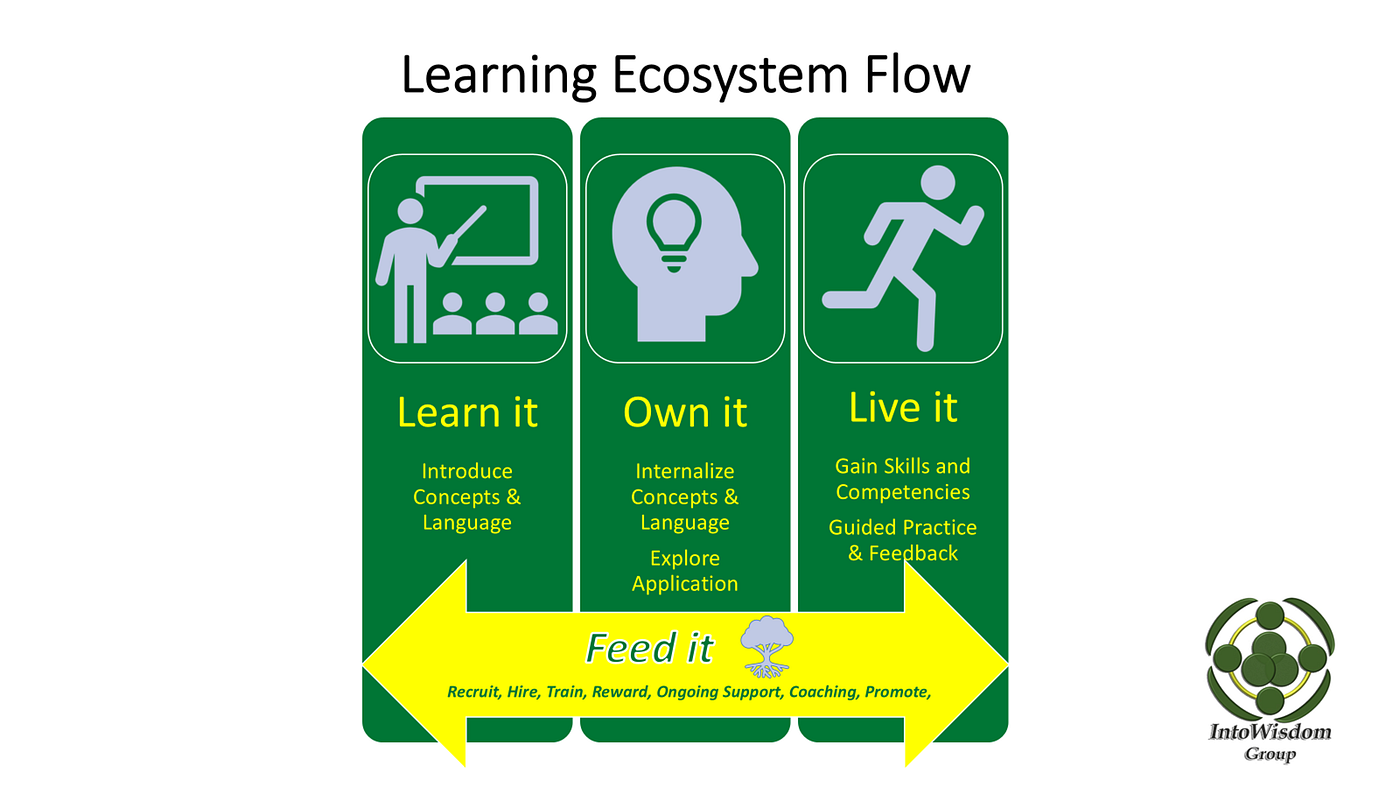
When building a learning or training program, consider the Learning Ecosystem Model:
· Learn it — Distance learning through well-designed e-learning courses (but can include memos, interactive PDFs, and slide decks) works best to introduce concepts, create a shared language around a topic, and can help to build an appreciation for the importance of the training.
· Own it — The language and concepts must be internalized by the learner; move from an external idea to an individualized ownership of the common concepts. This internalization comes through reflection and discussion. Thoughtful interactions happen on discussion boards and other asynchronous platforms. Virtual workshops (Synchronous Virtual) on Zoom or MS Teams can be very effective as well. A well-facilitated, in-person discussion is also a powerful way for people to own the concepts and languages.
· Live it — Skill and competency development, feedback, and guided practice (coaching) work best in person. Few competencies can be effectively developed in the virtual context (writing may be one example). Most practical training topics need the in-person context to be developed.
· Feed it — Any learning gained through training programs does not last if it is not supported. Content retention lasts under a week, and any skills or performance improvement gained begin to decay after a few weeks (TCTEC Innovation, 2025; Texas A&M, 1998). For training to be effective, it needs to be supported by the entire organization through recruiting, hiring, training, ongoing support, coaching, rewarding, and promoting. The skills and competencies being trained will never survive if HR, Sr. Leadership, and management do not “buy in” to the objectives.
Example:
To enhance customer service and sales efficiency, “Regional Trust Bank,” a medium-sized financial institution, must train its branch employees on a newly implemented customer relationship management (CRM) system. Instead of relying solely on the annual two-day conference, they adopted a Learning Ecosystem Model. This involved employees completing pre-training microlearning modules on the CRM’s interface and data privacy protocols (Learn It), participating in virtual simulations and role-playing exercises to practice using the CRM in common customer interactions (Own It), integrating the new CRM system into their daily tasks at the branch, with support from designated “CRM champions” and readily available job aids (Live It), and receiving ongoing support through a dedicated internal help desk, regular webinars highlighting advanced CRM features, and a peer-to-peer forum for sharing success stories and troubleshooting challenges (Feed It). This comprehensive approach will lead to faster CRM adoption, improved data accuracy, increased customer satisfaction, and a more streamlined sales process.
Using the Learning Ecosystem as you design your training curriculum will increase its impact and make your programs more cost-effective.
Longitudinal Learning
Don’t base your programs on Event-Based Learning or Stand-Alone Training if you want to reach learning objectives, change behavior, and build competencies. As stated at the start of this article, these approaches do not have a sustainable impact. Linking learning opportunities and events offers training and development that leads to better retention and skill mastery, along with improved “real-world” application (HR Professionals Magazine, 2019; ATS, 2024)
“Linking learning opportunities and events offers training and development that leads to better retention and skill mastery…”
Longitudinal learning, spreading learning experiences over time, creates more effective and efficient technical and professional development. It allows learners to participate in more diverse learning experiences and increases autonomy and self-direction in their development (key components of adult learning).
Example:
A national retail chain shifted from annual product knowledge seminars to a longitudinal learning approach for its store associates to improve customer service and sales performance. This included pre-seminar online modules on company history and customer service basics (Learn It), followed by in-person training on advanced sales techniques and handling difficult customer interactions (Own It). Associates then applied these techniques on the sales floor, with regular coaching and feedback from store managers (Live It), and had access to a mobile app with product updates, sales tips, and a peer forum for sharing successes and challenges (Feed It). This resulted in higher customer satisfaction scores, increased sales revenue, and improved employee retention, demonstrating the effectiveness of longitudinal learning in fostering lasting behavioral changes in a retail environment.
While longitudinal learning may have higher upfront costs for design and take more time, these investments more than pay for themselves in impact and ROI (HR Professionals Magazine, 2019; NIH, 2022). Linking in-person programs, e-learning, virtual workshops, and asynchronous support, retention of concepts and skills, along with application, increases significantly over any of those methods when applied alone.
Longitudinal Learning Design Templates:
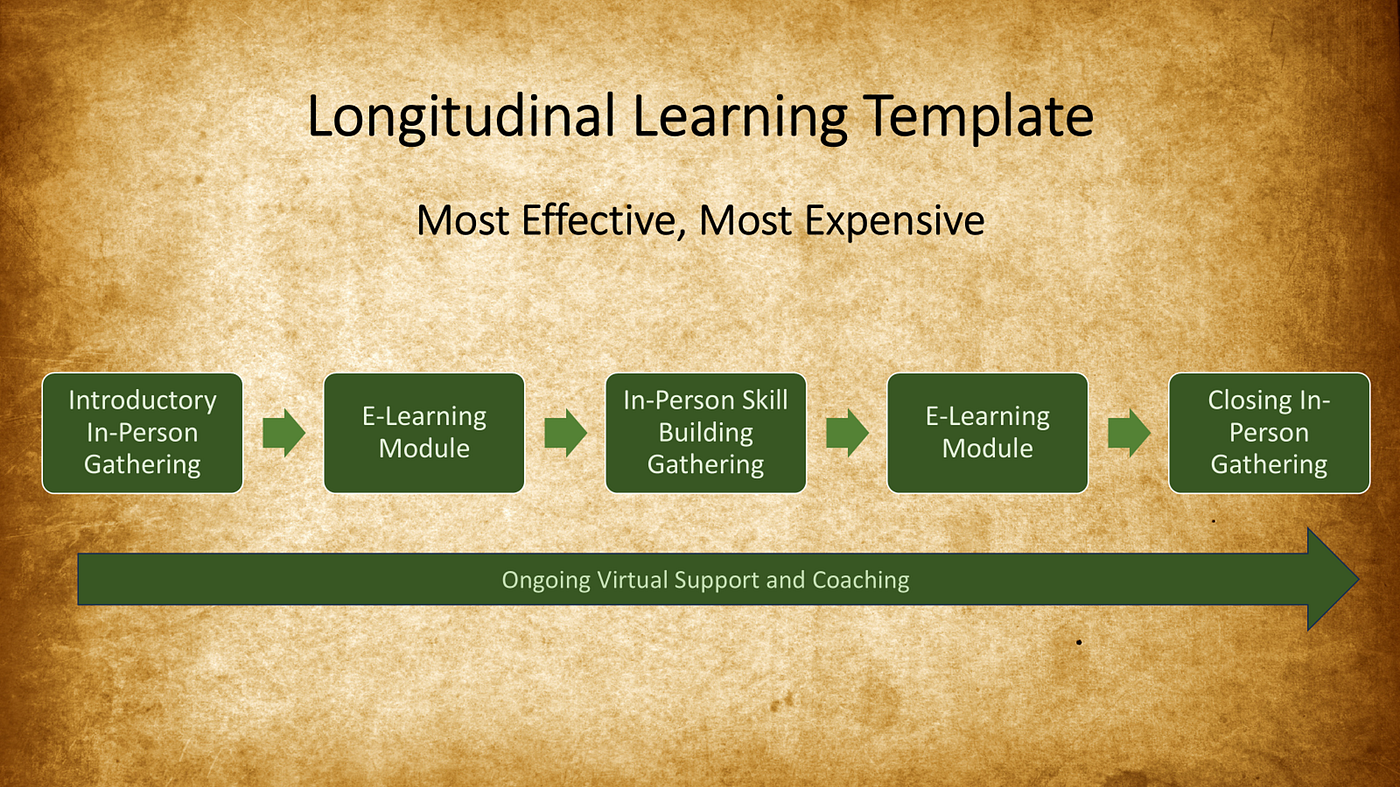
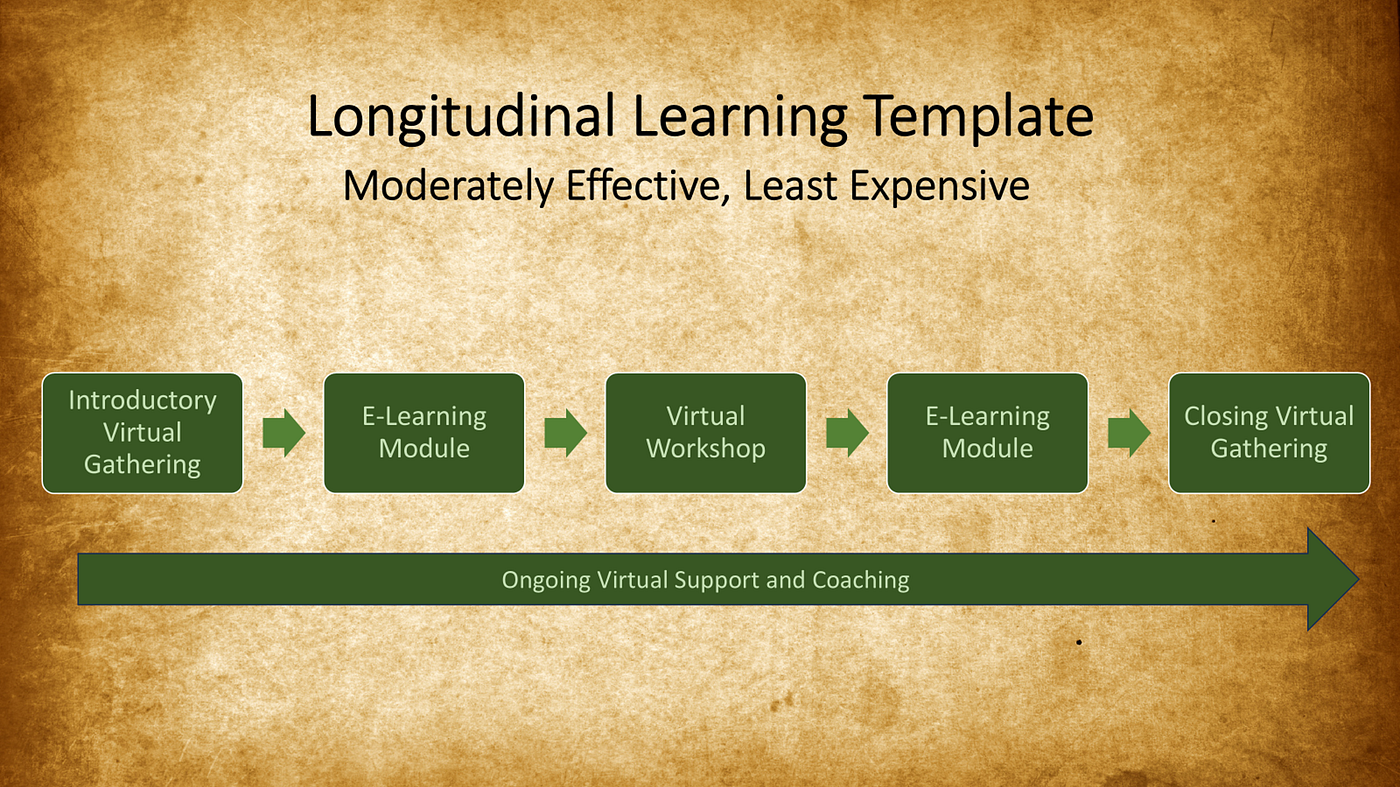
The diagrams below offer simple roadmaps to create longitudinal learning programs at varying costs:
Most Effective, Most Expensive
Moderately Effective, Least Expensive
Moderately Effective, Moderately Expensive
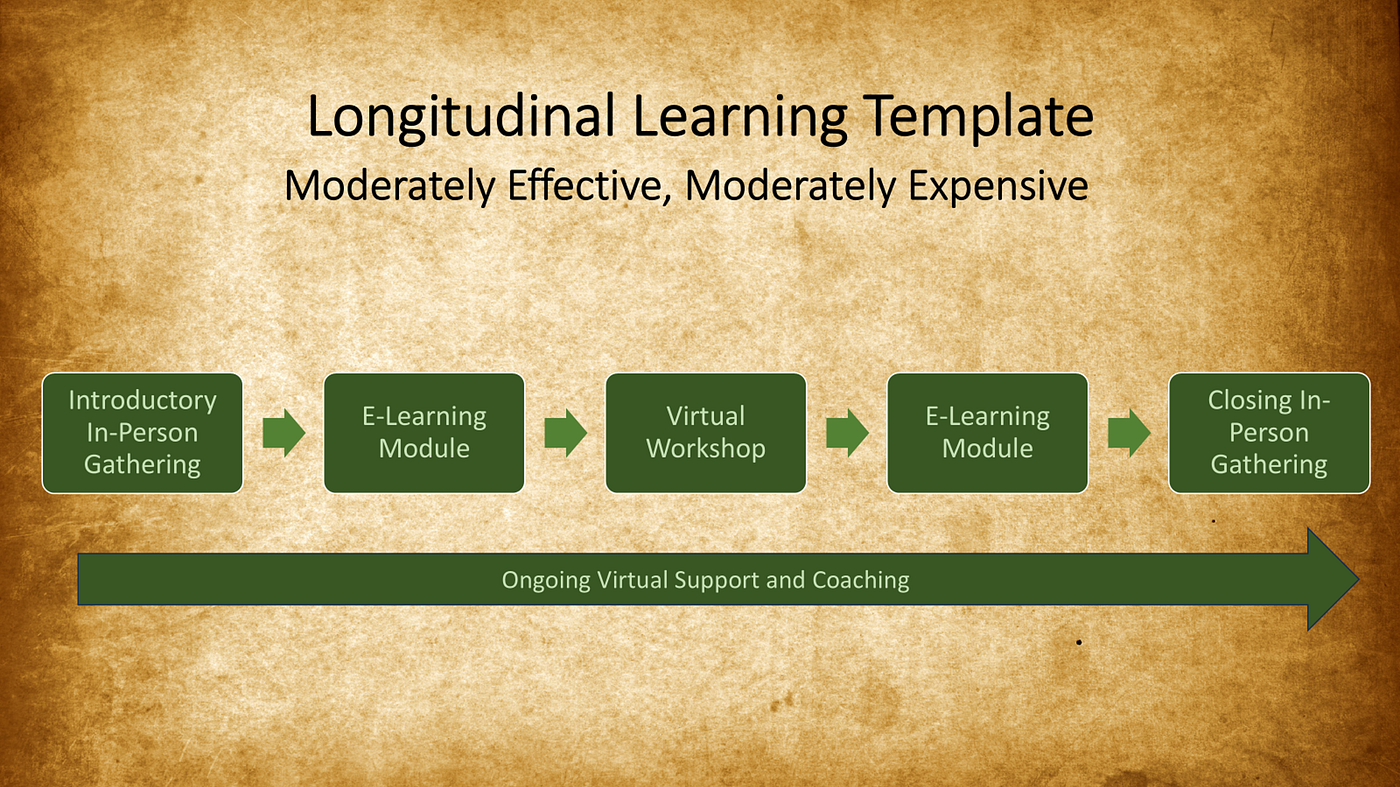
While these templates offer a high-level view of linking different learning environments, the effort and intentionality in designing each opportunity will make the difference in the power and sustainability of your curriculum.
Event-based training is fading. As learning leaders and practitioners, we stand at a crossroads. We can continue down the path of stand-alone events, or we can choose to forge a new path — one that embraces the power of longitudinal learning, the richness of an integrated ecosystem, and the transformative potential of maximizing in-person time. This new path isn’t about abandoning in-person programs, but about elevating them. It’s about creating a holistic, sustainable learning experience that truly transforms individuals and organizations.
What if your next training program didn’t just deliver information, but sparked a lasting transformation? Challenge your assumptions about learning and ask yourself: How can I leverage the power of longitudinal learning to create a truly impactful learning ecosystem?
Do you want to learn more about the Learning Ecosystem and Longitudinal Learning? Contact IntoWisdom. We can guide to applying these models and help you design and deliver powerful learning experiences. Our learning design experts can help you build a course that brings the content to life.
Use this link to set up a time to explore possibilities.
(All images by Adobe Stock, Pexels, and John Losey)
(AI was used in this article for research, grammar, and feedback. All content is the work of the author. The author has significantly edited any contributions from AI.)
This article first appeared on Medium.