

Sometimes I get so excited about addressing an issue or solving a problem, I forget my clients aren’t just organizations, but these organizations are made up of people.
We’re hired to bring solutions, right? As consultants pride ourselves on identifying opportunities, strategizing interventions, and driving measurable results. But we often overlook a critical piece: our recommendations are change events for our clients. We miss the human side of change. And that’s where projects fail.
The Case of the Cost-Cutting Consultant:
Sam, a rising star at a prestigious consulting firm, landed a lucrative project to streamline operations for a manufacturing company. His analysis was brilliant: eliminate redundancies, automate processes, and outsource non-core functions. The projected cost savings were impressive, and the client eagerly signed on. Sam and his team dove in, implementing the changes with ruthless efficiency. Systems were revamped, roles were eliminated, and new technologies were deployed. The results were immediate: production costs plummeted. Sam celebrated a job well done.
Six months later, however, the client called, furious. Employee morale was at an all-time low, productivity had slumped, and turnover was skyrocketing. Sam had focused so intently on the change that she completely ignored the transition. She hadn’t considered the impact on the people whose lives were upended, the skills they would need to learn, or the grief they felt at losing familiar routines. The project was a disaster, and Sam’s reputation took a hit.
Too often, we’re so focused on the strategic “what” and operational “how” that we neglect the very human “who” – the people whose daily routines and established ways of working are about to be upended. As change agents, there are forgotten but foreseeable consequences of the change initiatives we implement. If we genuinely want our solutions to stick, we need to become masters of not just problem-solving but of change management, and transition management.
Change vs. Transition: Understanding the Difference That Makes All the Difference
It’s crucial to distinguish between change and transition. Change is situational: a new system, a revised structure, a fresh marketing campaign. Transition, on the other hand, is psychological. It’s the internal process people go through as they grapple with that change. It’s the messy, emotional work of letting go of the old and embracing the new. As William Bridges noted in his seminal work on transition, this is about endings, the neutral zone, and new beginnings. Ignoring this transition piece is a recipe for resistance, disengagement, and, ultimately, project failure.
Organizations Change. People Transition.
The Consultant’s Integrated Toolkit: Change and Transition Frameworks
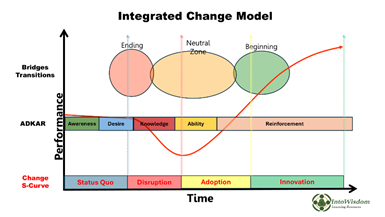
- The Covey Change Curve: Use this to anticipate your client’s performance journey. Where are they on the curve? Your interventions should align with their current state.
- Bridges’ Transition Model: Facilitate endings, navigate the neutral zone, and help them embrace new beginnings. Actively acknowledge losses, provide clear direction, and celebrate early wins.
- ADKAR (Awareness, Desire, Knowledge, Ability, Reinforcement): Use ADKAR to structure your communication and training plans. Does the client truly understand the need for change? Do they desire to participate? And finally, what reinforcement mechanisms are in place to sustain it?
How the Models Work Together
While distinct in their focus, these three models provide a comprehensive toolkit for change leaders. Think of them as different lenses through which we can view and navigate the complex landscape of organizational change:
- The Change Curve is our roadmap, showing the journey from Status Quo to Innovation. It gives us a bird’s-eye view, helping us anticipate the hills and valleys ahead.
- The Transition Model, on the other hand, zooms in on the individual’s internal experience. It’s our guide to the emotional landscape, helping us understand and address the very human reactions to change.
- ADKAR is our compass, guiding us through each stage of change. It ensures we equip clients with the right tools at the right time.
We create a powerful, multi-dimensional approach to change management by integrating these models. We’re not just plotting a course; we’re understanding the terrain and equipping our travelers for the journey ahead.
Applying the Integrated Approach
Imagine you’re orchestrating a complex symphony of change. Each model plays a crucial role in creating harmony:
In the early stages, as the organization is still in its Status Quo (Change Curve), focus on building Awareness (ADKAR) while acknowledging the Endings (Bridges) that people are facing. It’s about setting the stage, creating a compelling case for change while empathizing with what’s being
left behind.
As we move into the Disruption phase (Change Curve), we’re dealing with the heart of the Endings (Bridges). This is where fostering Desire (ADKAR) becomes crucial. We’re not just pushing for change; we’re addressing fears, highlighting benefits, and creating a sense of urgency that resonates on a personal level.
The Adoption phase (Change Curve) aligns with the Neutral Zone (Bridges). Here, our focus shifts to building Knowledge and Ability (ADKAR). We’re providing the tools, training, and support needed to navigate this uncertain territory.
As we approach Innovation (Change Curve) and New Beginnings (Bridges), Reinforcement (ADKAR) takes center stage. We’re celebrating victories, providing feedback, and embedding changes into the organizational DNA.
Throughout this journey, we’re constantly monitoring progress, adjusting our approach, and ensuring that no one gets left behind.
Benefits of an Integrated Approach
By weaving these models together, we’re creating a change management tapestry that’s far more robust and effective than any single approach:
We gain a 360-degree view of the change process, considering both the organizational trajectory and the individual’s emotional journey. It’s like having both a telescope and a microscope at our disposal.
We can anticipate and address resistance more effectively by understanding its emotional roots (Bridges) and systematically working through barriers (ADKAR).
Our interventions become more targeted and impactful. We’re not just throwing solutions at problems; we’re applying the right strategies at the right time based on where the organization and individuals are in their change journey.
Our communication strategies become more nuanced and effective, addressing both the rational case for change and its emotional impact on individuals.
Ultimately, this integrated approach significantly increases the likelihood of successful, sustainable change. We’re not just changing processes or structures; we’re transforming entire organizational ecosystems, ensuring that change takes root and flourishes.
By embracing this holistic approach, we as consultants can truly deliver on our promise of transformative change. We’re not just problem-solvers; we’re change architects, building bridges between the present and a more successful future for our clients.
Actionable Advice for Consultants:
- Know and articulate the “Why”: It’s not enough for you to know the need for the intervention. You need to be able to articulate then need for the change to the organization and offer a strong case for why the people should buy into the change.
- Diagnosis is Key: Once you know how you will bring about the desired outcomes, dive deep into the organization and culture to assess the organization’s change readiness and identify potential resistance points.
- Keep in mind that you are initiating change and transition: Prepare the leadership for a dip in performance when change is activated and pushback from employees experiencing endings. Provide clear communication, training, and support throughout the transition process.
- Identify and Celebrate Transition Success: Define success and track those measures (i.e., employee engagement, morale, and adoption rates).
The Redemption of Sam:
Determined to learn from his mistakes, Sam took a deep dive into change management and transition management principles. When he landed a similar project at another company, he approached it differently. Before implementing any changes, he spent weeks interviewing employees at all levels, understanding their concerns and fears. He developed a comprehensive communication plan, explaining the why behind each change and addressing potential anxieties. He invested heavily in training and support programs, empowering employees to adapt to the new processes. Most importantly, he acknowledged the losses and celebrated the gains, fostering a sense of shared purpose and ownership.
This time, the results were dramatically different. The cost savings were still significant, but more importantly, employee morale remained high, productivity increased, and the company culture thrived. Sam had learned that true success wasn’t just about implementing change; it was about guiding people through the transition.
The Consultant’s True Value: Sustainable Change
Our value as consultants extends far beyond implementing new systems or restructuring departments. It lies in our ability to guide clients through complex transitions, fostering resilience and adaptability within their organizations.

As consultants, we have the power to shape not just processes and structures, but the very culture of the organizations we serve. Let’s commit to being mindful of the ripple effects our recommendations create. Before your next engagement, pause and ask yourself:
- Have I considered the human impact of the changes I’m proposing?
- Am I prepared to guide my client through both the change and the transition?
- How can I ensure that the changes I initiate lead to sustainable, positive outcomes for all stakeholders?
By embracing our role as change leaders and transition guides, we can elevate our practice and create truly transformative experiences for our clients. The next time you meet with a client, ask yourself: Are you designing solutions—or guiding transformation? True success isn’t measured by the speed of change but by how deeply it takes root. Are you ready to lead clients through change and lasting transition?