

The pyramid on the whiteboard, the fan on the ladder

I’ve seen at least five 70–20–10 posts on LinkedIn this week. Last week it was Maslow — four separate people, four separate pyramids, all posted like discoveries. The algorithm seems to rediscover these models on a cycle, the way certain plants only bloom every few years, except this bloom shows up in my feed every few months whether I want it or not.
If you don’t work in learning or leadership, stay with me anyway. This is about more than training or org charts. It shows up anytime someone hands you a tidy answer to something that was never tidy to begin with.
Here’s what usually happens when I point that out. Someone will write a long, thoughtful-sounding comment. It starts with agreement — great points, and I think there’s real value here too. Then, a few sentences later, without ever quite disagreeing, the whole thing quietly argues the opposite. I’ve started calling it agreement toast. Someone lays down a full slice of agreement, then covers it, in plain sight, with the actual disagreement on top.
I don’t think people do this because they’re wrong. I think they do it because some part of them suspects I might be right, and doesn’t want to fully say so. That reaction is actually evidence for the thing I’m about to argue, not against it.
Start with 70–20–10
If you’ve spent any time in learning and development, you know the model. Seventy percent of learning happens through experience, twenty percent through others, ten percent through formal training. It’s clean, it’s memorable, it fits on one slide, and I have used it myself in more workshops than I can count.
Here’s the part almost nobody mentions when they cite it. The whole thing traces back to a single study — a survey of executives asked to look back and guess what had helped them grow. That’s not nothing, but it’s not what people treat it as. It’s one group’s memory of their own success, dressed up as a formula. And memory is a generous editor. It remembers the dramatic stretch assignment and quietly drops the hundred small conversations that did just as much work.
I don’t think 70–20–10 is wrong, exactly. I think it’s simplistic — in the specific sense that the word implies something arrived at too quickly, before the harder work was done. It looks like an answer. It functions like one, right up until you try to build a real development plan on top of it, and discover the three numbers don’t actually tell you anything about how they connect to each other.
Maslow has the same problem
I’ve written before about how Maslow’s pyramid works better as a description of what self-actualization can look like than as a prescription for how to get there. The same gap shows up here. Maslow’s hierarchy resonates. It has resonated for eighty years, which is no small thing. But it was built mostly from studying a handful of remarkable people, not from broad research into how everyday people are actually motivated. It gets used as a ladder to climb in order, even though Maslow never framed it as a rulebook.
Two different models, two different decades, two different domains. Same underlying flaw. Both are clean. Neither is especially well supported. Both get treated as more finished than they are.
One model actually holds up
Herzberg’s two-factor theory doesn’t get nearly the airtime that Maslow or 70–20–10 do, and I think that’s mostly because it’s less photogenic. It doesn’t stack into a pyramid. But it’s backed by real research, and more importantly, it gets the shape of the thing right in a way the other two don’t.
Herzberg found that what makes people miserable at work and what makes people motivated at work aren’t opposite ends of the same scale. They’re two separate systems, and they interact. Fix the hygiene factors — the pay, the conditions, the policies — and you don’t create motivation; you just remove a source of misery. Motivation comes from somewhere else entirely, and it doesn’t arrive by climbing a ladder. Hygiene and motivation are not sequential but related.
That one distinction — relationship instead of hierarchy — is the whole argument of this article, said in miniature.
The mountain
There’s an image I keep coming back to whenever this comes up. Picture complexity on one axis and elegance on the other. The line starts low and simplistic, climbs up through complicated and genuinely complex, and comes back down the other side to something simple again.
Here’s the part that matters. Simplistic and Simple sit at almost the same elevation on that chart. From a distance, they can look identical. The difference is that one of them climbed the mountain to get there, and the other one never left the parking lot.
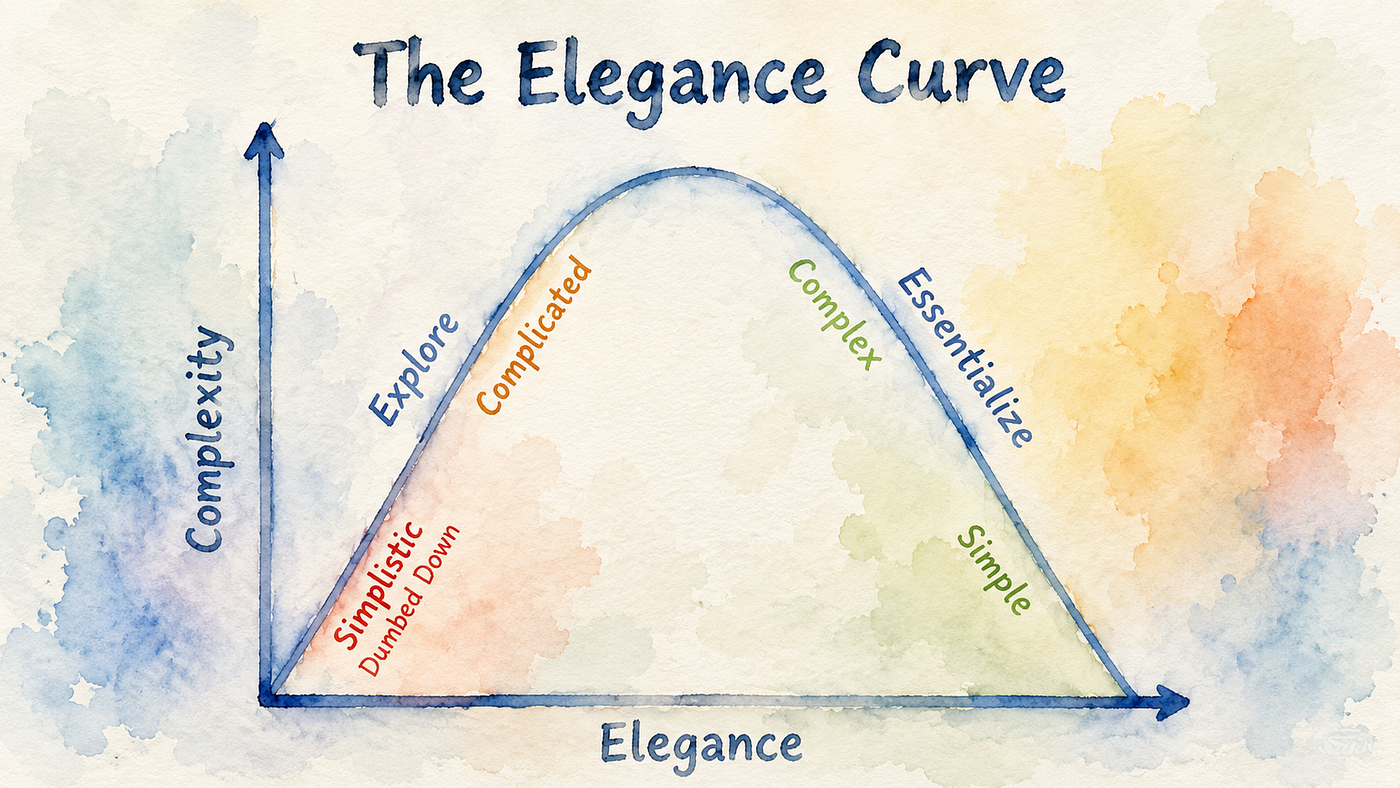
70–20–10 and Maslow haven’t made that climb. They’re camped at the bottom, dressed up to look like they’re standing at the summit. That’s not an insult to either model, or to anyone who’s built a workshop around one. Most of us reach for a hierarchy for the same plain reason: it’s far easier to hand someone a triangle in forty minutes than to walk them up a mountain, and most of us are working with a lot less than forty minutes. It’s just an honest description of where these models are, not a judgment of the people carrying them.
And it explains agreement toast perfectly. When someone defends 70–20–10 at length without ever quite disagreeing with me, what they’re often defending, without realizing it, is a position on the near side of the mountain as though it were the far side.
The same shape shows up in leadership
I’ve told this story before: the insurance company whose file quality scores climbed while the actual quality of the work fell apart underneath them. Leadership brought in a measurement system, the scores went up, and everyone quietly learned how to satisfy the number instead of doing the work the number was supposed to represent. Nobody was cheating. They were responding rationally to what got rewarded.
That’s the same mountain, at a different altitude. Being data-driven sounds disciplined and rigorous. It’s often just as simplistic as a pyramid on a whiteboard, because it never says which data, weighted against what judgment, checked against what context. Being data-informed is messier. It admits a human being is still in the loop, still weighing things a spreadsheet can’t weigh. It’s less elegant to say out loud in a meeting. It’s a lot closer to true.
And then it shows up at home
I thought replacing a ceiling fan would take under an hour. It took a week, and three fans, before I understood why.
The first fan, I treated like a simple swap — old fan off, new fan on, done before lunch. Three hours later, surrounded by parts I didn’t remember removing, I finally got it hung. Bad luck, I told myself. A stubborn bracket. A fluke.
The second fan taught me otherwise. What I’d missed the first time started showing itself: the bracket depended on the box, the box depended on the wiring, and the wiring depended on decisions someone else had made in this house long before I owned it. None of it was separate. Four connected problems, and I’d been treating them like four unrelated chores. That one took about an hour.
The third fan took less than half that. Not because I’d become an electrician, or a builder, or a designer — I’m still none of those things. Somewhere between the first fan and the third, I’d simply stopped seeing four disconnected tasks and started seeing one system, understood well enough to work with instead of against.

Rushing was never what made the difference. Seeing what was actually connected to what, finally, was.
Learning, leadership, life
This started with a pyramid on a whiteboard and a survey nobody questioned. It ends with a ceiling fan.
In learning and development, the shortcut looks like a hierarchy — three neat percentages or a triangle of needs, clean enough to fit on a slide and just true enough to survive there. In leadership, it looks like a dashboard, a number standing in for the thing it was only ever meant to describe. In life, it looks like whatever you’re currently certain will only take an hour.
None of these shortcuts are wrong exactly. They’re simplistic — reached for because they’re faster, not because anyone reaching for them is careless. A triangle is easier to hand someone than a system. Most of us are just working with less time than the truth deserves.
The other side is real, though. It’s just never where you expect it, and it never arrives on the first try.
It’s still worth the climb.
Further reading, if any of this struck a chord:
● When the Spreadsheet Becomes the Boss
● The Simplicity Worth Crossing the Desert For

(AI was used in this article for research, grammar, and feedback. All content is the work of the author. The author has significantly edited any contributions from AI. The insurance company experience, the analysis, the voice, and all substantive conclusions are the author’s own. Images by ChatGPT)
This article first appeared on Medium.