

Why the most important things are never as simple as they first appear — and why that’s good news

There’s a particular kind of tired that comes not from too much work but from too much noise.
You know the one. It settles in after scrolling through the news, closing a social media app for the third time, or sitting through a conversation where everyone was very certain and nothing was actually resolved. It isn’t confusion exactly. It’s the quiet sense that whatever just happened was not adequate to the reality it claimed to describe.
The world is complicated. That much is obvious. What’s less obvious — and what almost nobody seems willing to say out loud — is that most of our responses to that complication aren’t.
Oliver Wendell Holmes said it plainly: “I would not give a fig for the simplicity on this side of complexity, but I would give my life for the simplicity on the other side.”
Most of what passes for clarity right now — in our politics, in our media, in our personal judgments of each other — is the simplicity on the wrong side. It arrived too fast, before the work was done. It feels like an answer. It isn’t. I call that simplistic.
The good news — and this article is fundamentally about good news — is that the other side is real. The path is not always comfortable. But what you find when you get there isn’t more confusion. It’s something that actually feels true.
The Desert You Have to Cross
Think of complication as the desert you have to cross to reach the promised land.
Not as punishment. Not as obstacle. As passage.
The desert appears in the great human stories not because it is pleasant or because the people who crossed it were uniquely brave, but because it is honest. You cannot go around it. You cannot wish it away. The only way to what waits on the other side is through.
That is the reframe — and it is a genuinely hopeful one. The complication you are facing, the grey area that feels so uncomfortable, the question that resists easy answers — these are not signs that something has gone wrong. They are signs that you are somewhere real, in the middle of a crossing that goes somewhere real.
The desert is not the end of the story. It is the middle of it.
And knowing that — really knowing it, carrying it with you when the sand is in your teeth, and the destination is not yet visible — changes everything about how you walk.
Simplistic Is Not Simple
The crossing begins with knowing where you are.
These two words — simplistic and simple — sound alike. They are opposites.
Simplistic is what you get when you stop too early. It’s the first answer, the obvious take, the explanation that requires the least and accounts for the least. It has the shape of clarity. But it’s clarity purchased before the work is done — and that cost, eventually, always comes due.
Simple — genuine, earned, elegant simple — is what remains after you’ve moved through the mess. It accounts for the complexity without being overwhelmed by it. It carries weight because it was earned, not assumed.
The difference between them is not intelligence. It is patience. The willingness to stay in the difficult place long enough for something true to emerge.
Easy Does Not Make It Right
We have developed a deep cultural appetite for the quick take. The confident answer. The clean narrative that tells us who’s right and who’s wrong before we finish our morning coffee.
Singer-songwriter David Wilcox — whose spare, honest songs have been quietly finding the people who need them for decades — has a line that stops you cold: “Easy does not make it right.”
Just six words. The work of a philosophical treatise.
The quick answer isn’t wrong because it’s easy. It’s not enough because it arrived before the work was done. And incomplete answers offered with complete confidence have a way of making things worse — slowly, quietly, in ways we rarely connect back to the answer we settled for too soon.
Nowhere is this more visible than in our public life. The systems that shape our public conversation have evolved to reward the confident quick answer over the careful considered one. The person who says “this is more complicated than it appears” is read as weak or evasive. The person with the sharp, certain answer — regardless of whether it accounts for what’s actually happening — is read as strong and clear.
This pattern runs across every corner of the political landscape. That isn’t a both-sides argument about the merits of any position. It’s an observation about a shared human tendency that our current moment has turned up to full volume.
The people who feel most discouraged right now are often the ones paying the closest attention — the ones who can see the gap between the complexity of what’s actually happening and the inadequacy of most conversations about it. That gap is real. And exhausting.
But seeing it clearly, even when what you see is messy, is always the first step toward something better.
It Has to Get Messy Before It Gets Good
This is not a metaphor. It is a pattern.
Marie Kondo’s instruction for organizing a closet is almost uncomfortably direct: pull everything out first. Make the pile on the bed. Confront the full reality of what has accumulated before you decide what stays. The moment of maximum mess is not a setback. It is the necessary first act. You cannot sort what you haven’t faced.
Greg McKeown makes the same argument in Essentialism. The essentialist doesn’t begin by eliminating. They begin by exploring — honestly, openly, without rushing toward a conclusion. Before you can know what is truly essential, you have to reckon with everything that is not.
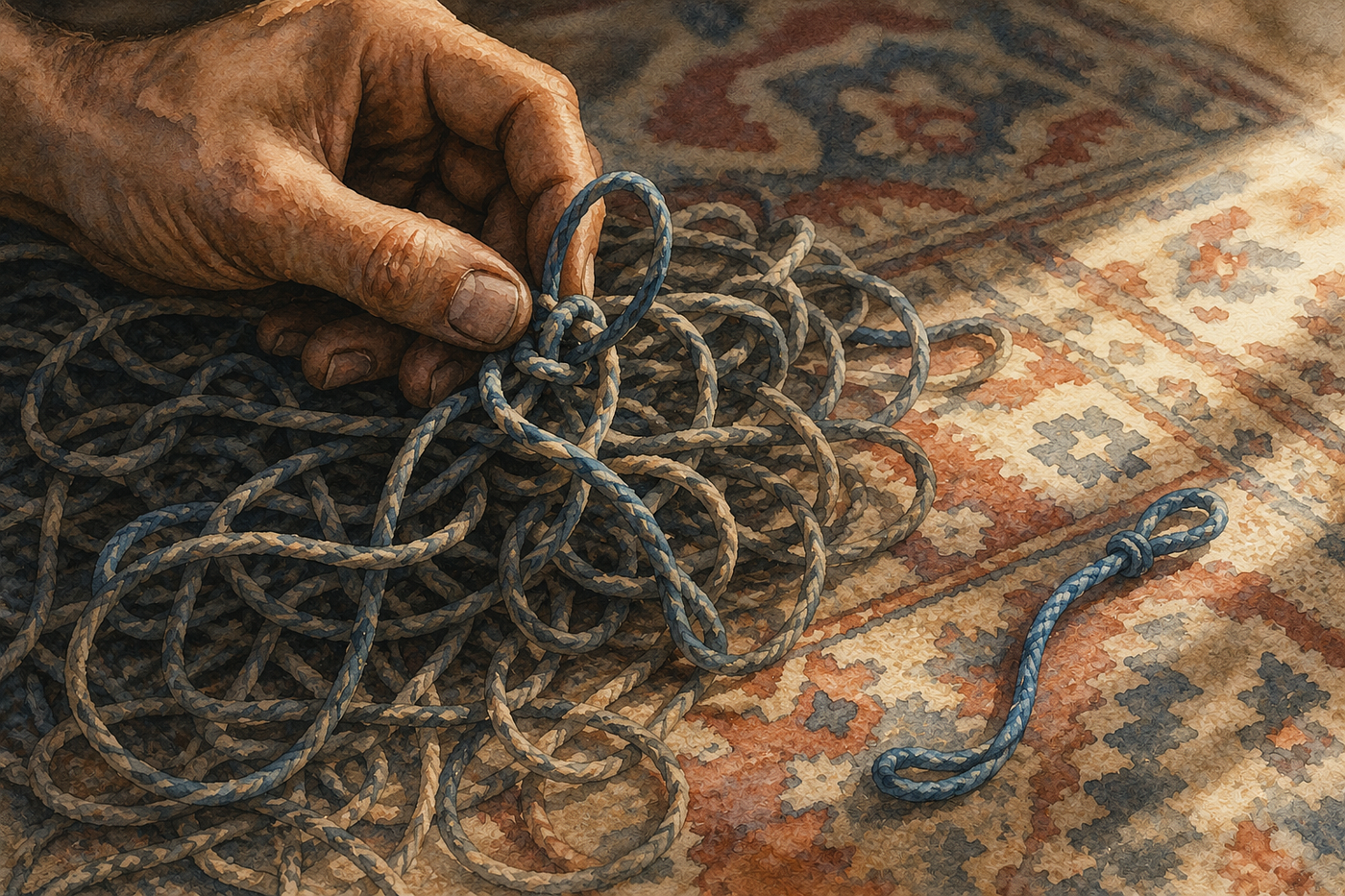
I’ve written about this before through the image of the P-Cord — the lightweight camping rope that was invaluable until you put it away carelessly. The next time you pulled it out, you had a hairball of a tangle that looked, at first glance, completely hopeless. (The full story is here, if you want it.) The temptation was always to declare it lost and reach for a new rope. But the ones who stayed with it — who worked it patiently, one loop at a time — always got it untangled. The rope was never broken. It was waiting for someone willing to do the work.
The mess is not the enemy. It is the desert you are crossing. And the promised land is not around it or above it.
It is through it.
The Space Between
Viktor Frankl wrote that between stimulus and response, there is a space. In that space is our power to choose. In our response lies our growth and our freedom.
That space is exactly where the move from simplistic to genuinely simple occurs. Simplistic thinking collapses it entirely — something happens, an answer arrives, the case is closed. Genuine understanding is the work of keeping that space open long enough for something true to enter it.
Every platform, every notification, every system engineered for immediate reaction is working against that space. The person who protects it — who resists the first answer long enough to find a better one — is doing something the world is not currently making easy.
They are also, almost always, the person whose thinking turns out to matter most.
A Word About AI
The tools are remarkable. Used well, AI can be a genuine companion on the journey toward complexity and, eventually, toward simplicity.
Used carelessly, it does something else entirely.
The first response arrives polished, fluent, apparently complete. It has the shape of a conclusion. And if you stop there — if you take the first output and move on — you have used the most sophisticated information tool in human history to arrive at a simplistic understanding faster than you could have managed alone.
The difference is what you do next. Push back. Ask the follow-up. Challenge the first response. Say — yes, but what about this? The complexity begins to emerge. The nuance surfaces. The genuinely useful insight starts to take shape.
The tool is not the problem. The stopping point is. And the stopping point is always a choice.
You Have to Be Willing to Suck to Get Good
The elegant, simple, true thing almost never arrives fully formed. It passes through an earlier version of itself that is shallow, incomplete, possibly embarrassing.
Most people never get past that version — not because they aren’t capable of better, but because they stop before they get there. They confuse the discomfort of the messy middle with evidence that they’re on the wrong track.
They aren’t. The discomfort of the messy middle is almost always evidence that you’re exactly where you need to be. It means you’ve gotten far enough in to feel the complexity, which means you’ve gotten far enough in to eventually find the simplicity on the other side.
Mr. Rogers understood this more deeply than most: “Deep and simple is far more essential than shallow and complex.”
Deep and simple. Not simplistic. Not complex for its own sake. The thing that has gone all the way through and come out the other side carrying only what was essential.
John Cleese, writing about creativity, described two modes of mind. The closed mode is efficient and decisive. The open mode is slower, more comfortable with not-yet-knowing, and it is where genuine insight is born. You cannot reach a creative solution without first tolerating the discomfort of not having one.
The open mode is the desert. The insight is the promised land. Every path runs through the middle.
The Light Is Real
The world is genuinely complicated. You are right to notice. You are right to feel the inadequacy of simplistic answers being offered on every side of every question.
Your discomfort with easy certainty is not weakness. It is a form of honesty — about the world, about yourself — that this moment needs more than almost anything else.
The path toward the simplicity Holmes said he would give his life for is available to anyone willing to do three things.
Stay with the mess a little longer than feels comfortable.
Ask the next question instead of accepting the first answer.
Trust that what you find on the other side — the elegant insight, the true thing, the understanding that actually accounts for reality — will be worth what it costs to get there.
It always is.
The desert is real. The crossing is real. The discomfort is real.
And the promised land on the other side — the simplicity that is deep and earned and true — is more real than anything you’ll find if you turn back now.
Keep going.
The mess has something worth finding in it.
And you are more capable of finding it than you think.

© 2026 The IntoWisdom Group.
(All images by Adobe Stock, Chat GPT, and John Losey)
(AI was used in this article for research, grammar, and feedback. All content is the work of the author. The author has significantly edited any contributions from AI.)
This article first appeared on Medium.