
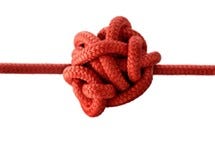
The shrieks of frustration jolted me from my task — another blond head bent in agony over the same tangled mess of cord. Not thirty minutes earlier, Josh had stood in that very spot, his small brow furrowed as he wrestled with the latest knotted disaster. I watched him yank hard on both ends, vainly trying to untangle by force what could only be undone by purposeful care. Soon, he tired, shooting me a defeated look before seeking more manageable tasks. Now Emma confronted the same foe, her young face scrunched in concentration as she searched for slack amidst the pulls and bindings. I felt every emotion flash across her features — confusion, annoyance, despair — a microcosm of reactions we as a people have toward the complicated knots we encounter in life and work. It was time to intervene, to gently minister to frustrations born of haste and over-simplification. Crouching down, I spoke softly, “Here, let me show you a trick that helps with the tough ones…” If only more leaders, faced with a complicated situation, chose the open-hearted wisdom of simplicity over swift, superficial fixes.
If only more leaders, faced with a complicated situation, chose the open-hearted wisdom of simplicity over swift, superficial fixes.
“It’s complicated.” I usually use this phrase to avoid discussing something I can’t fully explain or haven’t thought through. It’s looking at a rat’s nest of a tangled rope, not knowing if it can ever be untangled. It’s easier to dismiss the mess as “complicated” and ignore it or offer a reaction that may or may not address the issue.
Working in the outdoors with children and adults, “P-Cord” or “Gold Line” was an essential part of our supplies. These strong but very lightweight lengths of thin rope proved invaluable for all kinds of camping and quick-fix applications. They could be used repeatedly. The problem was wrapping them up for re-use. The next time you pulled them out, unless you were very careful, the P-Cord would be in a nasty “hairball” of a tangle.
In every program, I would come across at least one camper (usually more than one) holding a mess of a knot with a confused or frustrated look on their face. It was interesting to watch how they handled the situation. Some would immediately hand the mess to me, saying, “Fix it!” Others would toss the perfectly good P-Cord away and look for a different solution. Still, others would look over the complicated tangle, find the two loose ends, and tug firmly. This didn’t fix the mess. It just turned the tangle into a knot that would be even more difficult to undo.
I usually kept extra lengths of untangled cord with me to exchange for their tangle (hopefully before they turned the tangle into a tight knot). When I had an open minute or two, I would focus on the complicated mess in the cord. Instead of taking a simplistic approach of tossing it out, pulling on the ends, or cutting it up, I would gently push and tug on different loops to see where there were crossovers, twists, or bends. Often, what appeared complicated was just a few simple twists that occurred when the cord wasn’t coiled properly after its last use. A few simple twists in the opposite direction solved the problem, and I could give that line to a different camper facing cord complications. Other solutions weren’t so apparent. A deeper look at the mix of crossovers, twists, and loops revealed a complex, even elegant, series of knots that, once understood, could be addressed by undoing each unique knot individually. By not avoiding the complicated tangle I was presented with, I gained an understanding of the issue’s complexity. By exploring the complexity, I found simple solutions that allowed me to untangle the cord or, at least, save the greatest length to maintain the most usefulness for that cord.
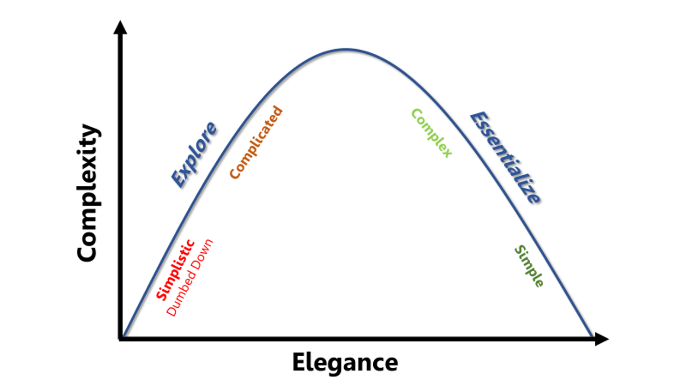
We all face complications, problems, situations, or issues that look like a nasty “hairball” of a knot. More often than I care to admit, I offer the simplistic, “dumbed-down” solutions that do not address the true complexity of the issue. It’s complicated, and I don’t want to expend energy to understand what’s happening, so I react with the first answer that comes to mind. This isn’t a simple answer. It’s a simplistic (having the appearance of simple) reaction.
It’s got to get messy before it gets good.
This statement is true of almost everything. In Marie Kondo’s process for organizing a closet (outlined in her fantastic book The Life-Changing Magic of Tidying Up), one of the first steps is to remove everything and make a big, messy pile on the bed. In his book Essentialism, Greg McKeown starts with exploration. Before you can begin to essentialize, you must know what’s there. You need to explore the messiness before you can know what is of value. Figuring things out and finding practical and elegant solutions requires you to unpack everything, explore the complications to reveal the complexity, and distill the essential elements that compose a simple solution.
The Senior Vice President presided over the seven directors meeting around a massive oval table in a large, wood-paneled boardroom. After discussing the challenges facing the group, the SVP ended the meeting with a challenge. “I want to hear your solutions in our next meeting. You have a week to come up with your best ideas.” The directors left the Wednesday morning meeting with a clear call to action. Six directors emailed their solutions to the SVP by Friday afternoon. Their ideas were obvious and simplistic. The seventh director continued to explore the issues and challenges over the weekend. As she worked it out, she started down one path that seemed to create more problems than it solved. She continued to develop a more elegant solution through Tuesday afternoon.
At the Directors Meeting that Wednesday, each director presented their solutions. As each director offered their solution, the SVP pressed them with pointed and informed questions. Most ideas were quickly discounted as the questions revealed holes and gaps in their thinking. It was evident that those who presented their first or second ideas hadn’t gone deep enough into the issue. When the SVP began to question the last director, who used all the time allowed, he found she had considered and anticipated most of his questions and concerns because she spent time exploring the complexity of the challenge. While the solution still needed work, her proposal offered a more considered and developed solution.
John Cleese, of Monty Python fame, is not only a brilliant comedian but an insightful and gifted business consultant. In a presentation on creativity in management, he offers seven guidelines for getting into an open, creative mode. Two of his seven points are “Time.” He recommends finding a space away from demands and doing this for a specific amount of time. The other “Time” factor is to sit with a problem longer. He tells a story of how he tended to produce more original or creative scripts than his more talented Monte Python colleague. His partner tended to develop the first or second idea he came up with. Cleese could stick with the problem longer, tolerate the discomfort of delaying a solution, explore the challenge, and play with ideas before moving toward a solution. Like the director developing a solution, Cleese recommends using all the time available to move through the complications to the complexity that leads to simple, elegant, and effective solutions.
Simplicity comes on the other side of complexity.
Complicated issues require us to do the hard work of exploring the mess to find and appreciate the complexity that will reveal an elegant, effective solution. Without overcoming my fear of the complicated, I cannot hope to come up with a response that accounts for what’s actually happening. Facing complications and stepping into them can create an appreciation for how the situation came to be, less obvious factors, and other potential resources. Complications turn into complexities that can be defined, understood, and addressed. Cause and effect relationships reveal themselves so that you don’t have to solve every issue, just the one or two issues that drive all the others. (check out the Pareto — 80/20 rule) That’s an elegant response to a complex issue. Simplicity accounts for the complex nature of an issue. Facing and diving into complications help us appreciate complexity and provide a measured, focused, and efficient response to difficult problems.
The sun had set over the red rock faces of Joshua Tree National Monument. Distant fires gave shape to the fading forms around me. Emma collapsed, smiling, her grimy hands still clutching her latest triumph. What was an insurmountable tangle just hours earlier was now neatly coiled and restored to use. Running her cord lovingly through her fingers, she raised innocent eyes to mine. “How did you know that would work?” In that gaze, I saw the promise that doing hard things leads to insights that help us understand and thereby conquer the messy complications of life that besiege us. I knelt once more beside her, the embers reflecting off tangled blond strands escaping her camp hat. “Start by focusing not on the tangle and the mess, but on why the tangle happened and the possibilities of solutions that might occur as we appreciate the complexity of the rope.” With care and presence, what first seems impossibly complicated transforms into purposeful complexity. Lead with curiosity and empathy first; clarity will follow. Our world needs more patient detanglers of cords. Slow down, be patient with yourself and the problem, move through the complications, and simple solutions emerge.

Are you facing an organizational “hairball?” Reach out to The IntoWisdom Group for help.
Image Credit: Adobe Stock & John Losey
This article first appeared on Medium.