
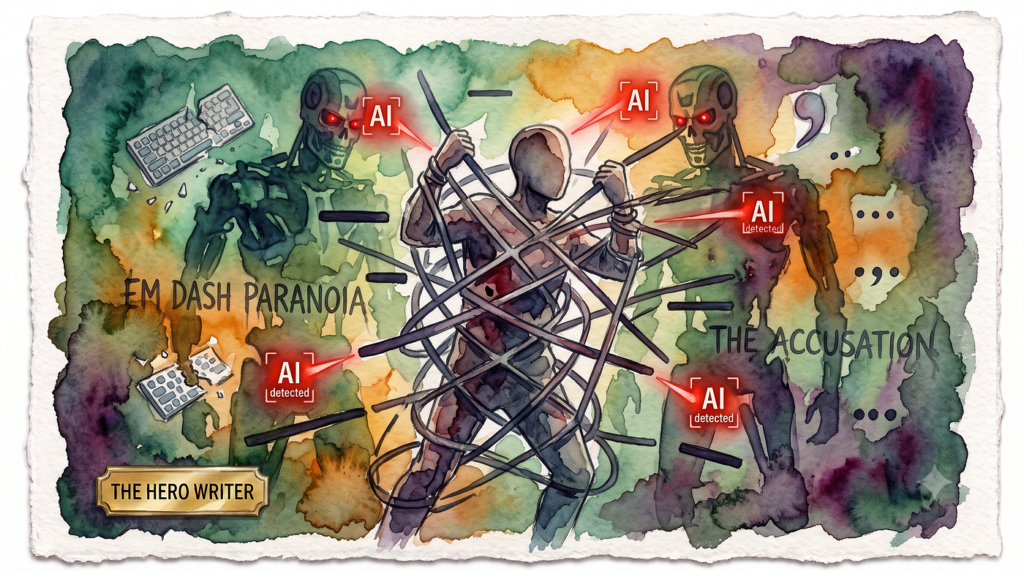
I’d spent several years digging into how to spot AI-written text when I heard the accusation land closer to home: em dashes were the tell. I didn’t stop to check if it was true. I just assumed I was guilty and started looking for the evidence against myself.
There was just one problem. I had never used an em dash on purpose in my life. I didn’t know what one was. If you’d shown me a sentence with a dash in it, I’d have assumed it was a typo or a hyphen having an identity crisis.
I want to be clear about the sequence of events here, because I think it matters: I accused myself of a crime I did not have the technical ability to commit, and I convicted myself before anyone asked for a defense.
Did that stop me from panicking? It did not.
The Great Em Dash Purge
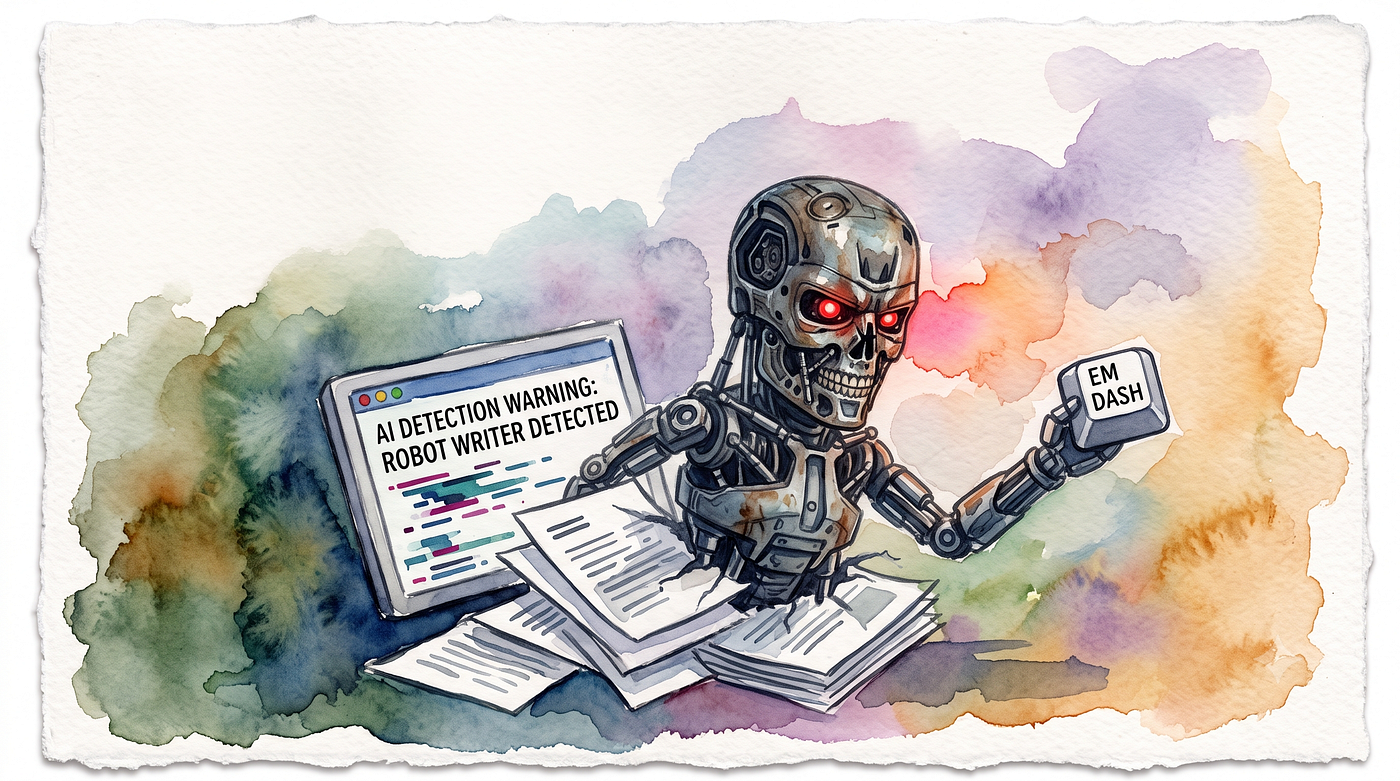
Somewhere on the internet, a rumor had taken hold that the em dash was AI’s calling card — the punctuation equivalent of the Terminator forgetting to put on its skin before leaving the factory. Writers everywhere started treating it like contraband. I saw the posts. I absorbed the paranoia. And even though I had zero em dashes to hide, I went on a purge anyway, hunting through my own writing for a mark I had never planted, just to make sure.
This is the writing equivalent of looking for the monster under your bed you know isn’t there.
I leaned on the punctuation I did have — commas, parentheses, a respectable hyphen — and leaned on it badly, stretching each one to do a job it was never built for, just to avoid the one mark I thought would give me away. I was so afraid of accidentally sounding like a machine that I started writing like someone who’d read one article about cholesterol and thrown out every egg in the house.
And here’s the part that still makes me laugh: I couldn’t have used an em dash even if I’d tried. I didn’t know how to make one. It’s not on the keyboard. There’s no dedicated key labeled “guilty.” I found out, entirely by accident, that if you type a word, then two dashes with no space before or after, then the next word, your computer will quietly stitch them into an em dash for you, like a tiny elf fixing your punctuation while you’re not looking. Three years of low-grade panic, and the solution was two keystrokes I’d been sitting on the whole time.
What the Dash Does
Once I stopped running from the thing, I got curious about it, which is generally how you should approach anything you’ve been irrationally afraid of.
It turns out even the Terminator gets a sequel where he’s the good guy. Turns out the em dash isn’t a glitch or a tell. It’s a tool, and it does something commas and parentheses can’t quite manage.
Take a sentence like this:
I learned how to type an em dash, thanks to AI.
Fine. Functional. A comma, doing its job, no complaints.
I learned how to type an em dash (thanks to AI).
A little aside, tucked away, almost apologetic.
I learned how to type an em dash — thanks to AI.
That last one has a beat to it. A little intake of breath before the point lands. It doesn’t just separate the thought — it performs the pause.
That’s the whole trick of the em dash. It’s the punctuation equivalent of stopping mid-sentence because you just thought of something better to say. It helps the reader hear the sentence, not just read it.
And it turns out I’m in decent company. Emily Dickinson built entire poems out of little else — dashes strung together like she didn’t have time for a period to catch up with her. Virginia Woolf let sentences run until they were nearly out of breath, the dash the only thing holding the thought together long enough to finish it. Faulkner never met a piece of punctuation he couldn’t out-stubborn, and the dash was one of his favorite ways of doing it.
Nobody ever accused any of them of being a robot. They just had more thought than the sentence could comfortably hold, and the dash was where they let the extra part in.
The Mark Can Also Ruin Your Life
None of this means the em dash is a free pass. Used badly, it’s not a pause — it’s a pileup. I’ve seen — and done it myself — sentences that use three em dashes to do three completely different jobs, and by the third one, the reader has no idea if they’re reading an aside, an interruption, or a fourth thought that showed up uninvited and refused to leave.
Something like: I went to the store — which was closed, by the way — to get milk — because we were out — and ended up buying cereal instead.
That’s not a sentence anymore. That’s a hostage situation.
The em dash works because it signals something specific — a break, a pivot, a thought interrupting itself. If you use it for everything, it stops meaning anything, the same way a friend who says “literally” about everything eventually gets no credit when something is actually, literally on fire.
The Sequel
Here’s the part I didn’t see coming. The tool that accused me of writing like a machine is the same one that sent me back to relearn a trick Dickinson, Woolf, and Faulkner had already figured out a hundred years earlier. AI didn’t teach me the em dash. It just scared me into finally paying attention to it.
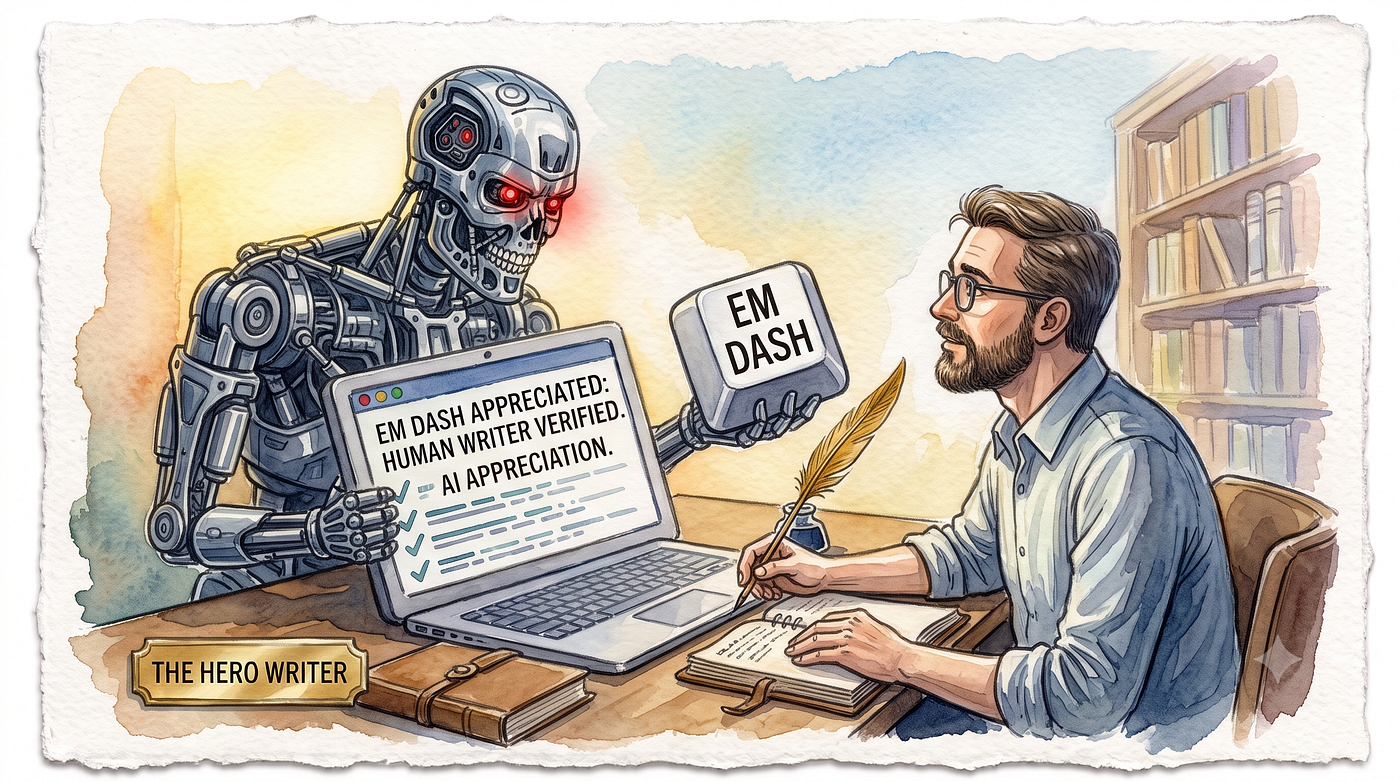
Now I use it on purpose. Not because a machine might, and not because I’m worried about being caught not using it either. I use it because it’s the only mark I’ve got that sounds like the pause actually happening in my head — the little hitch before the sentence tells you what it really meant to say.
Turns out the thing I was running from the whole time was just good writing, wearing a disguise I’d invented myself. And like every good Terminator movie, the one that came for me first is the one that ended up on my side.
© 2026 The IntoWisdom Group. This article is part of an ongoing series on facilitation, leadership, and organizational life.
(AI was used in this article for research, grammar, and feedback. All content is the work of the author. The author has significantly edited any contributions from AI.)
(Images by Gemini)
This article first appeared on Medium.