

When organizations aspire to higher engagement, resilience, and sustainable excellence, one approach rises above the rest: performance coaching. Much more than an HR trend or a remedial tool, performance coaching is an everyday, in-the-flow practice that, when embraced widely, shapes the very fabric of a company’s culture.
Performance Coaching: The Engine for Growth
At its core, performance coaching is about building individual capacity and competency: helping people “do more, better,” in ways that are practical, holistic, and sustainable. Unlike executive coaching, which is often external and focused on top leaders’ decision-making and presence, performance coaching can be woven into the daily interactions of managers, peers, and individual contributors at every level.
The value lies in making coaching accessible and normal, not a rare privilege or a last-resort intervention, but a shared responsibility and opportunity for growth.
Does Coaching Work? Here’s What The Numbers Say
- Employee Engagement: Organizations with strong coaching cultures see employee engagement rates of 65%, nearly three times the global average engagement rate of 21%. Higher engagement translates into more motivated, productive teams.
- Revenue Growth: Companies fostering coaching cultures report 46% more revenue growth compared to their competitors. This shows a strong direct business impact of embedding coaching.
- Return on Investment (ROI): Some studies find returns as high as 788% ROI on coaching initiatives. This means substantial financial benefits relative to the investment.
- Turnover Reduction: At MD Anderson Cancer Center, building an internal coaching culture led to a 48% decrease in turnover among coached leaders compared to control groups. That’s a major savings in recruitment and retention costs.
- Promotion Rates: Coached employees at MD Anderson were promoted at rates 41% higher than their non-coached counterparts, supporting leadership pipeline development.
- Team and Leadership Impact: Coaching cultures contribute to stronger leadership, improved teamwork, and higher levels of collaboration and employee satisfaction. MD Anderson’s teamwork favorability jumped from 65% to 86% over several years of coaching culture growth.
- Improved Productivity and Retention: Coaching cultures reduce burnout by about 20% and boost team performance by up to 50%, according to studies cited by the Association for Talent Development and the International Coaching Federation.
- Leadership Development: Coaching accelerates leadership readiness, improves strategic alignment, decision-making capabilities, emotional intelligence, and resilience — all crucial for organizational agility and success.
- Culture Shift: A coaching culture transforms leadership styles from directive to developmental, with managers asking more questions and helping people find their own answers, building internal capability at scale.
- Coaching Accessibility: Successful coaching cultures integrate coaching at all levels with internal coaches, trained managers, and external practitioners to ensure all employees have development opportunities.
Sources: Primeast, July 2025, ATD, April 2025, Gallup, 2025 & 2023, execonline, 2021
Internal, Sustainable, and Scalable
Because performance coaching is often internal, it empowers leaders and team members to act as “thinking partners” for one another. This creates a multiplier effect:
- Managers build more trust, unlock potential, and enable direct reports to solve their own challenges.
- Colleagues grow together, exchanging candid feedback in an environment of psychological safety.
- Individuals learn to reflect, adapt, and take ownership of their progress, fostering self-reliance rather than dependence on outside experts.
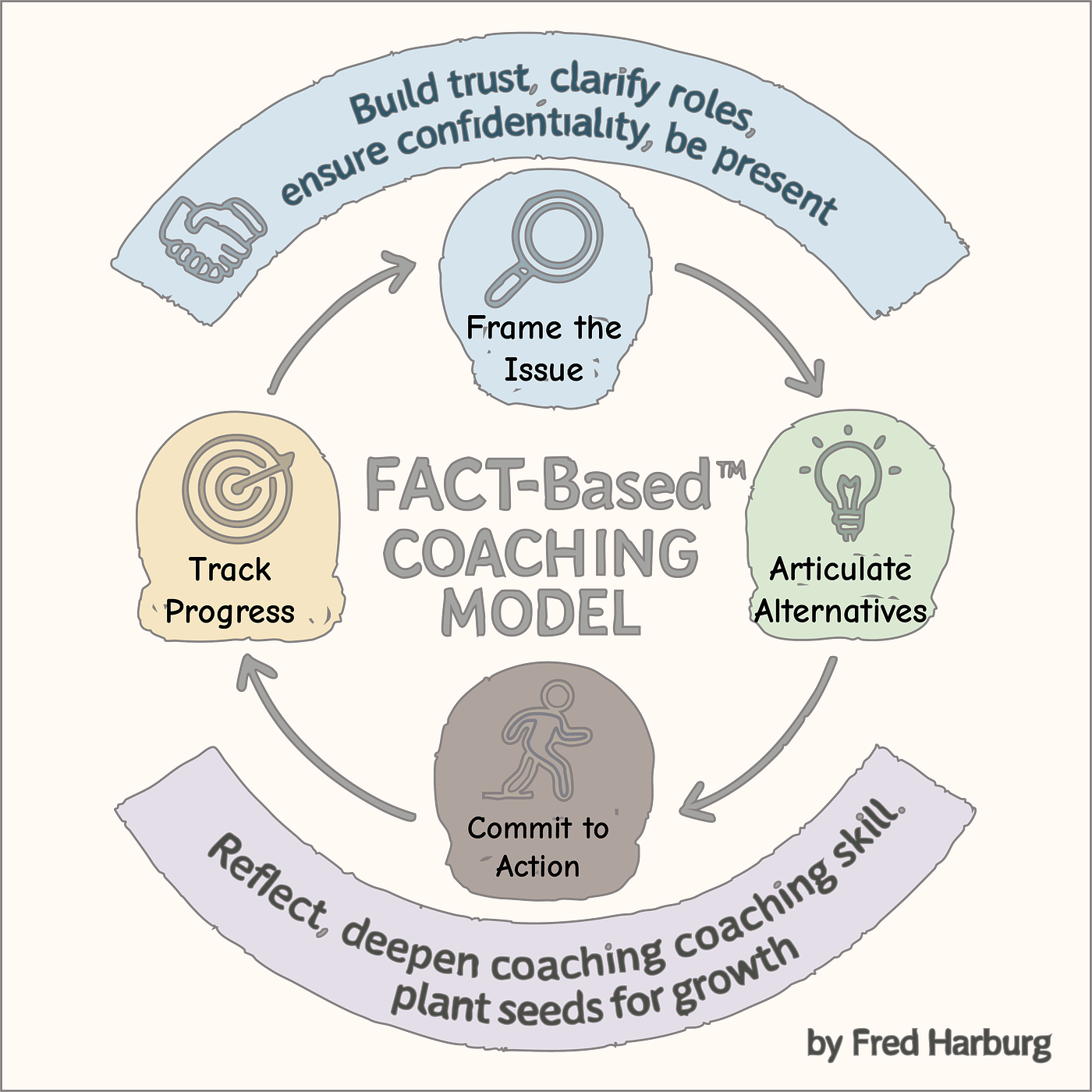
By distributing coaching skills broadly, using proven processes like Fred Harburg’s FACT-Based™ Coaching model, organizations seed a developmental mindset that never relies on any single person, but thrives through mutual commitment and dialogue.

Elena is a supervisor in a large insurance company. She didn’t think much of coaching. Then she listened more, talked less. Her team got sharper. Trust climbed. “I don’t fix things now,” she said. “I build people.”
Creating a Coaching Culture: Everyone Leads, Everyone Grows
A “coaching culture” is not built top-down or bottom-up alone; it emerges when everyone sees themselves as both a learner and a catalyst for growth. The most successful organizations view coaching as a fundamental leadership responsibility and an everyday skill, not a special event.
Key ingredients include:
- Shared language and framework (such as the FACT-Based™ model): Frame the issue, Articulate alternatives, Commit to action, Track progress — all underpinned by trust and ongoing reflection.
- Role modeling by leaders: When leaders routinely coach (not just direct or advise), they signal that development is valued and expected.
- Integration with everyday work: Performance coaching happens in hallway conversations, 1:1s, project retrospectives, and team huddles — not just formal sessions.
- Focus on strengths and growth: Instead of “fixing,” coaching leverages what’s working, clarifies purpose, and builds deeper capacity over time.
The result: engagement rises, collaboration flourishes, and the organization becomes more agile and adaptable — ready to tackle tomorrow’s challenges with confidence.
The Role of Leaders and Individual Contributors
Leaders set the tone for this culture by embracing their role as coaches and empowering others to do the same. This means:
- Asking powerful questions instead of offering quick answers.
- Investing in relationship and trust (“form foundation”).
- Supporting both the technical “what” and the relational “how” of development.
- Celebrating wins and learning from setbacks (“track progress”).
- Modeling humility, curiosity, and a commitment to one’s own growth (“synthesis”).
But it’s not just up to leaders. Every team member can contribute by listening openly, sharing feedback with care, and seeking opportunities to help colleagues think through challenges. Over time, this creates a positive “coaching virus” that spreads throughout the organization.
The Unique Value of Performance Coaching
Performance coaching distinguishes itself by being internal, scalable, and growth-focused. Executive coaching is valuable, especially for senior leaders navigating complexity, but it tends to be delivered externally, cost-prohibitive, and reserved for a select few.
Performance coaching turns coaching into an organizational norm. It’s about everyday conversations, not exclusive events. This democratization of coaching fuels a high-performance, high-engagement culture.
The takeaway: When leaders and individuals across the organization embrace performance coaching, they don’t just increase skills — they transform culture. Coaching becomes the heartbeat of the business: fueling growth, unlocking potential, and empowering people at every level to lead and learn together.
By investing in performance coaching, organizations ensure sustainable success is not just possible; it becomes inevitable.
Conclusion & Call to Action
Building a coaching culture isn’t just a forward-thinking strategy; it’s one of the most effective ways to boost engagement, deepen trust, and unlock lasting performance gains across your organization. By embracing performance coaching as a shared, everyday practice, you make continuous growth and high performance part of your company’s DNA.
Ready to take the first step?
Partnering with the IntoWisdom Group means equipping your leaders and teams with practical, research-backed tools to drive real change. If you’re curious how this could look in your organization, consider booking a free framing session and explore what’s possible.
But whether or not you choose IntoWisdom, take action. Invest in your people. Start open conversations about coaching. Seek out training, resources, or frameworks that fit your context. What matters most is making the decision to move from intention to action — building a culture that helps everyone “do more, better,” every day.
Want a proven place to start?
Book your complimentary framing session with IntoWisdom Group and begin mapping your strategy for organizational growth and a thriving coaching culture.
Don’t wait for the perfect moment. Take action for your people — whether with IntoWisdom or another path. The most important step is the first one.

(All images by Adobe Stock, Copilot, Pexels, and John Losey)
(AI was used in this article for research, grammar, and feedback. All content is the work of the author. The author has significantly edited any contributions from AI.)
This article first appeared on Medium.