

You know the feeling before you know the reason.
You step into a room, and your body has an opinion before your brain does. Some rooms feel bright. Some feel flat. Some feel tight, like everyone is waiting for a shoe to drop. Ten seconds in, you already know if this is going to be light work, slow drag, or a knife edge.
We call it reading the room. Most people leave it there. You do not have to.
This is about what you are actually noticing when you say you can feel a room, and about seeing groups as living systems, not just a pile of separate people in chairs.
How groups grow up
Groups develop over time. Whether it’s minutes or years, when people are together, things change. Bruce Tuckman gave us a simple way to think about how groups develop over time. Forming, Storming, Norming, Performing. Below, I’ve added a few notes based on my observations over 30 years of facilitating. You do not need to use these words in front of people. You just need the gist.
- Forming — Who, what, and when of the group. Who is invited to the group? What topic or task is the group forming around? When and where will this group meet? The forming stage involves the logistics of coming together.
- Conforming — New and careful. People are polite, a little stiff, and watchful of what is safe. Being unsure of behavioral expectations, people carefully watch each other and avoid standing out until they have a better understanding of the group.
- Storming — When someone takes a risk by asking a real question or acting authentically, group conformity is challenged. Hot and bumpy. Real differences show up. There is more tension, more edge, more truth.
Caution — There is no guarantee that a group will move through storming. Some groups stay in “Conforming” and end up doing no real work. Understanding the role of conflict and good facilitation skills helps groups move through this.
- Norming — Processing the “storm” and identifying helpful individual and group roles and behaviors builds a foundation for progress. The tension promotes authenticity, and things are starting to click. The group finds its rhythm, builds some trust, and can name tension without blowing up.
Caution — Norming isn’t always a one-time event. New storms may arise as the group progresses. Surviving one storm/norm doesn’t guarantee surviving the next.
- Performing — If you’ve been a part of a high-performing group, you know the feeling of flow. It’s not always easy, but it’s solid and moving. People share leadership. Conflict gets leveraged instead of being buried. The focus stays on the work.
- Dissolving — Ending groups intentionally is just as important as forming groups on purpose. Anticipating and planning for the ending of a group helps identify progress and accomplishments. It also helps group members and the organization identify lessons learned in the process to apply to future group endeavors. Groups that end well are more likely to engage with the next group they join.
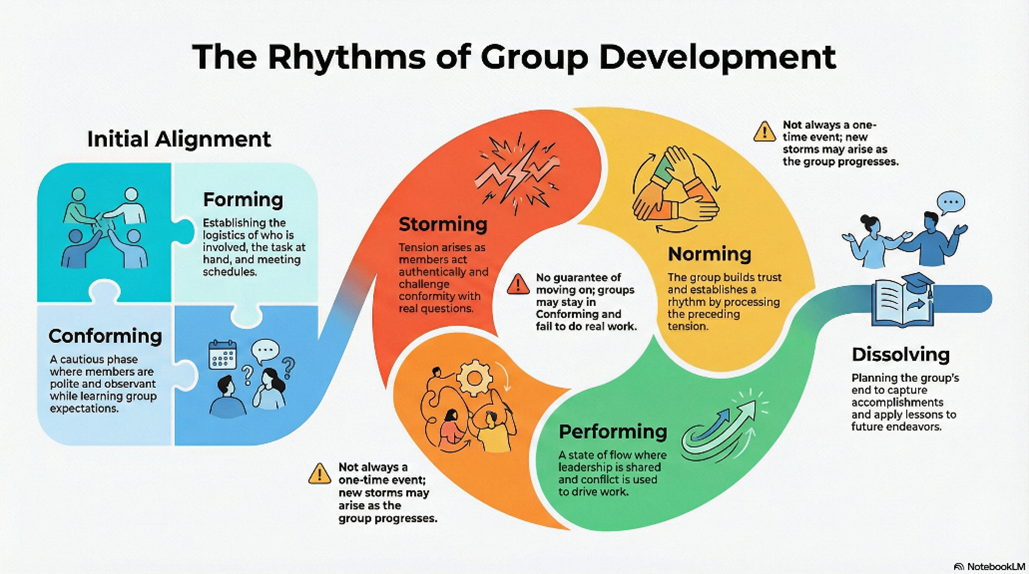
You already know these states in your bones. This process gives your gut a few simple handles.
What you really watch when you read the room
Reading the room is not magic. It is paying attention on purpose.
Who talks and who never does
- Roughly count who speaks and how often
- Notice who gets cut off and never tries again
- Notice who only speaks when you call on them
This shows you where power and safety live in the room, not just who is “outgoing.”
How people sit and where their eyes go
- Who sits in the middle, and who hugs the wall
- Who leans in and who leans away
- When someone talks, do eyes go to them, to you, or down to the table
If people only look at you, you are the real audience. If they look at each other, the group is starting to carry itself. If no one looks at a certain person when they speak, that is worth your attention.
The gap between words and feel
Sometimes the words sound fine, and the room does not. People say “that makes sense” with tight shoulders. They say “I’m okay with that” and then go quiet.
That gap between what is said and how it feels is often where the real work is hiding. When your skin says something is off and your ears hear “all good,” believe your skin long enough to get curious.
Caution — Know the difference between observation and interpretation. Reading the room doesn’t mean judging the room. The behaviors you see and the feelings you have are prompts for questions, not conclusions. Check your observations with honest questions before you interpret and make decisions.

Safety and risk in the room
People will not risk if they expect to be shamed, punished, or quietly sidelined for it. They might talk, but they will not really show up.
Psychological and social safety are the research terms. In plain language, it means “I can say what I see, ask for help, or admit I do not know without getting burned.” Teams show it by how they handle the first signs of risk.
Watch for
- Does anyone ever say “I don’t know” or “I missed that”
- What happens to the first person who disagrees out loud
- Can someone bring bad news without sugarcoating it
- Do people ask questions that might slow things down or add work
Low safety rooms are quiet in the meeting and loud in the parking lot. High safety rooms may sound messy, but the mess is on the table where you can deal with it.
When you say you are reading the room, you are often noticing, without naming it, how safe it feels to tell the truth.
Note: The facilitative leader manages psychological and social risks by acting in ways that demonstrate safe behaviors and by calling out/questioning behaviors that would decrease safety.
Safety lives in patterns too, not just in individual moments.
Systems, not villains
When a room feels off, it is easy to blame one person.
That guy. That team. That leader. The “negative” one. The “checked out” one.
Sometimes behavior does need direct questioning. Sometimes a person really is doing harm. But most of what you are feeling comes from patterns, not just personalities.
Groups build habits over time
- Someone always cracks a joke right when it gets real
- Someone always rescues the group when a question gets hard
- One person plays the role of “hard question asker” and pays the price
- The same three people decide while everyone else waits them out
If you pull the camera back, you see how these roles fit together. The jokers and rescuers keep things light because the group has no muscle for hard conversations. The “difficult” person does the work of naming what everyone else knows but will not say. The quiet ones learned, somewhere along the way, that speaking up ends badly.
Think of the iceberg:
- On the surface: moments you notice — the sigh, the eye roll, the sharp comment
- Under that: patterns — the same moves, the same people, again and again
- Under that: structures and rules — who gets invited, how decisions are made, how mistakes are handled
- Under that: beliefs — what people really think about conflict, leadership, difference, risk
Reading the room as a system means asking:
- Where have I seen this pattern with this group before
- Who benefits from things staying just like this
- What unspoken rule might be running this moment
You shift from “they are the problem” to “this is the pattern, and they are one part of it.”
That shift is where leadership begins.
Three things to count in your next meeting

While additional training might help, you do not need a new certification to improve at this. You need a pen, a scrap of paper, and one meeting you are willing to treat as a little field lab.
Pick one of these to count next time.
1. Talk time
Write down names or initials. Put a mark each time someone speaks.
At the end, look at the page
- Who filled it
- Who popped in once
- Who never showed up at all
You may not love what you see. That is fine. Now you are not guessing.
2. Interruptions
Mark each interruption. Who does it? Who gets interrupted? Does that person ever get to finish? You might find that the same people always get full airtime while others get stepped on. You might find your own name on the interrupter list. That is not failure. That is information.
3. Eye contact
Pick one person at a time. When they speak, watch where attention goes.
- Do people look at them?
- Do eyes slide back to you?
- Is there someone whose words never really land on anyone’s face?
This tells you whose voice carries weight and whose does not, no matter what the org chart says.
You do not have to show anyone these notes. They are not a report card. They are a mirror for you.
Call to action
Before your next meeting, decide who you want to be in that room and be clear about the topic and/or outcome.
Then
- Choose one thing to count
- Notice one pattern you have been pretending not to see
- Make one small move to shift it — invite one more voice, slow one hot moment, name one truth gently
You will not fix every pattern in an hour. You will start leading the room you actually have, not the one you wish you had.
That is what reading the room looks like when you do it on purpose.

(All images by Adobe Stock, Gemini, and John Losey)
(AI was used in this article for research, grammar, and feedback. All content is the work of the author. The author has significantly edited any contributions from AI.)
This article first appeared on Medium.