

My Most Excellent Day
What follows is an outline of what I consider my most excellent workday. I rarely hit 100 percent. But I aim small, so I miss small.
My ideal day overall? Waking at a tropical SCUBA resort with family, diving at dawn, exploring with my wife and son, ending in a bar with a guitar and house band. The workday I’m about to share is what I aspire to each day, the one that pulls me toward growth, even when life reshuffles the calendar.
Morning Ritual
Waking up is a wonderful way to start the day. It means you’re alive and have been given another opportunity to do stuff. My body wakes up before 6 AM most days. No alarm except on early travel days. Some swear early rising’s the key to success. Early rising works for my brain. I know night owls who thrive late. No judgment, just listen to your body. Plan around when you’re sharpest for the work that matters.
Beware the wallowing trap: waking but staying glued to the mattress. 45 minutes dissolve in half-sleep scrolling. Some days warrant slow starts: illness, holidays, rough nights with a sick kid. Just don’t make it the norm. Reserve that for special occasions.
Once my eyes open, I ease in. Two activating phrases as I move toward the bathroom:
“New every morning” focuses on promise: today’s a fresh start.
“One day at a time” anchors the grind.
Almost every day needs both.
Still in bed or walking, I look at three things:
Scripture or wisdom literature (10 minutes). For me, the Christian Bible. This grounds my primary identity before inbox surprises hit. Starting here helps me face urgent emails with breath instead of panic.
Email scan (3 minutes). Not to reply — to adjust expectations. Surprises shift priorities. By meditating first, I can delay reactions and reply thoughtfully later.
Calendar glance (2 minutes). What’s locked in? Where’s flex? This preview warms my brain while my body takes longer to move from horizontal to vertical.
I stretch, stand, and shuffle to the kitchen. My 12-year-old is also an early riser. We both graze on cereal, and I start the coffee.
Then I move to my brown recliner with my journal and a mug of fresh brew.
The Journal Moment
I don’t keep a diary. My journal is my “thought catcher,” a place to make lists, clarify thinking, and test ideas. This morning-time processes my first three things in the context of my activating phrases. Sometimes paragraphs flow. More often: a sentence or two, then task lists. Where do they fit? How will I spend my energy?
This is my first pass at aligning intention with reality.
My wife and I sync on getting our son fed and off to school. I usually wait until he leaves before heading for work.
“The in-between space offers a clean end to the morning and a clean start to your tasks.”
The In-Between Space
Whether I commute to an office or work from home, the movement between home and work creates a threshold. A transition for my mind to move from home to work. Commute or a stroll, both work.
I’ve discovered this transition matters more than most realize.
A few minutes allows your brain to move from home mode to work mode. The in-between space offers a clean end to the morning and a clean start to your tasks.

Desk Time
I reach my desk and fire up my computer. The first thing: music. A room without music feels empty to me. Keith Jarrett or Vince Guaraldi (Jazz) for focus. 1970s singer-songwriters for creative work.
Then I clock in and handle admin.
Email triage (under 20 minutes):
Is this spam? Delete.
Can I handle it in under 3 minutes? Do it.
Can I do something about it? Add it to a project or create a new file. Then schedule time to tackle it.
This clears mental clutter before deep work begins.
I check texts, social media, and task lists briefly, then adjust my calendar based on this new information.
Hack — Turn off notifications. Email gets checked 2–3 times daily. Chasing the inbox erases focus.
Now I’m ready to dive in.

Blocking the Day
My day chunks into meetings (45 minutes each) and deep project work (90-minute blocks).
Why these lengths?
Research shows cognitive performance peaks in the first 20 minutes of focused work, then gradually declines as mental fatigue accumulates, with measurable drops in reaction time and error rates after 60–90 minutes of sustained focus.(Frontiers in Psychology, Lohse and Sherwood, November 2011) The 90-minute block approach lets me ride that focus window before the cliff hits. It’s not grinding through fatigue; it’s using the time when my brain actually works best.
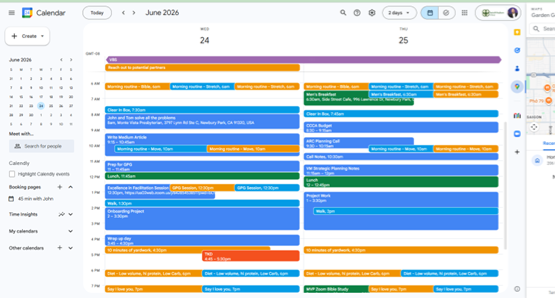
But I have to protect that window. No back-to-back meetings. No “just one more email.” The in-between space between blocks is non-negotiable. Just like the commute from home to work, transitioning from task to task allows for a clean ending and a new beginning.
“Walking away is how you stay sharp.”
I don’t schedule meetings back-to-back. Whether between meetings or between projects, when I change tasks, I stand, walk around, and reset. Sometime before lunch, I take a 15-minute walk. Mid-afternoon, another one. Not because I’m virtuous, but because staying at my desk creates an illusion of work while your brain declines. Walking away is how you stay sharp. (Brain.fm, 2025)
Ending the Day
At day’s close, I scan email one last time, adjust tomorrow’s calendar, and shut down. The music goes off last.
Then the walk or drive home becomes another transition. I use it to shed work stress, so I arrive home present, not frustrated. I’m less likely to transfer any lingering work emotions to my family.
The Reality
Do my days actually look like this?
Rarely.
Some mornings, I Pavlov-scroll and end up on social media instead of scripture. I’ve wallowed on weekdays for no reason. Early meetings mean skipping stretches. My son’s schedule or my wife’s business throws off my plan. Projects don’t follow linear calendars. Meetings cancel. Deadlines shift. I get lost in deep work and slog away at the computer for 3 hours. I stay at the desk late.
Why is it that workdays always get longer and seldom get shorter?
Why Outline the Most Excellent Day?
There’s an adage from target sports: Aim small. Miss small.
The more clearly I paint my target, the more precisely I can aim. If I fear missing the bullseye, I may never shoot. But fear of failure is also fear of learning. The target isn’t about hitting, it’s about how you missed and what that teaches you.
“My most excellent day isn’t permission to be perfect. It’s permission to aim.”
Creating this outline in detail helps me see growth opportunities. My most excellent day is aspirational on purpose. I know I’ll rarely nail it all. In being specific, I clearly see where I can improve.
On rare occasions when I hit 90 percent of what I outlined, I celebrate.
My most excellent day isn’t permission to be perfect. It’s permission to aim.
It pulls me into continuous growth.
What does your most excellent day look like? Start with blocks and transitions.
“Aim small. Miss small.”

(All images by Adobe Stock, and John Losey)
(AI was used in this article for research, grammar, and feedback. All content is the work of the author. The author has significantly edited any contributions from AI.)
This article first appeared on Medium.