

I’ve sat in a lot of training rooms. I know what the good ones feel like — the energy in the room when a skilled facilitator hits a nerve, the moment when a framework lands and you can almost hear people thinking. I’ve filled out the evaluation forms. I’ve circled fives. I’ve meant it.
And I’ve watched what happens next.
You leave the room with a workbook, a head full of ideas, and the best of intentions. Monday comes. The inbox is full. Three meetings before ten. The difficult conversation you hoped those new skills might help with — the one that doesn’t look anything like the role-play from Friday — is waiting before you’ve had your second cup of coffee.
By Wednesday, the workbook is still in your bag. By the following week, it’s on a shelf. A month later, almost nothing has changed. Not because the training was bad. Not because you didn’t pay attention. But because a single event, even a very good one, was never enough. It takes more than a day, or even a week of training, to develop skills and change behaviors.
We’ve known this for a long time. We keep doing it anyway.
The Real Problem
It’s not that leaders don’t care about development
In my work with organizations, I’ve rarely met a leader who didn’t genuinely want their people to grow. They book the trainer, clear the calendar, cover the cost. They’re trying. The commitment is real. What’s missing is a clear picture of what development requires.
Event-based training has become the default not because it’s the best option, but because it’s easy and familiar. A day off-site. A workshop. A guest speaker. These things are visible, schedulable, and easy to point to when someone asks what you’re doing about professional development.
What they’re good for is real. A well-designed training event can build shared vocabulary, spark awareness, and introduce a framework people can begin to apply. That’s not nothing. But awareness is not skill. Inspiration is not behavior change. And a single Friday is not a curriculum.
Think curriculum, not just event
Lasting professional development doesn’t happen in a room. It happens over time, across multiple contexts, with the right kind of support at each stage. In practice, that means treating learning as a system, one where each component does something the others can’t.
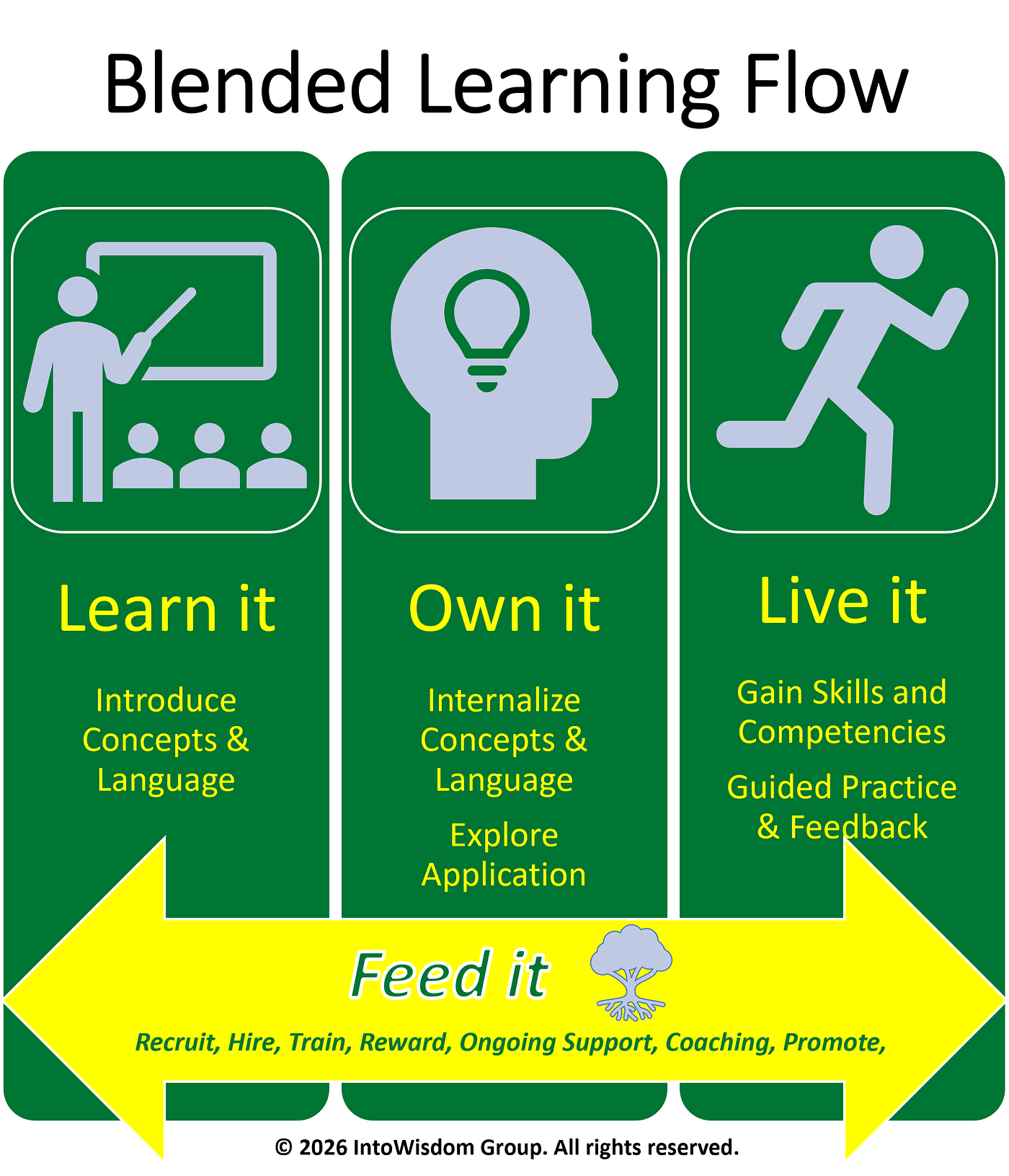
Asynchronous eLearning gives people knowledge at their own pace, when they need it, and something they can revisit as their understanding deepens. Live virtual sessions, a Zoom call, a team debrief, create space for application, discussion, and accountability between people who know each other’s work. In-person workshops are where complex skills get practiced, relationships deepen, and the messy relational parts of professional growth simply happen. And job aids, a checklist, a reference card, a two-page guide, a simple app, meet people at the exact moment they need support, not a week after a class where the idea came up and nobody wrote it down.
None of these alone is sufficient. Strung together deliberately, they become something different — a curriculum with shape, direction, and a fighting chance of changing how someone really works.
The question isn’t which format to choose. It’s whether you’ve thought clearly enough about what you’re trying to develop to know which combination of tools to reach for.
Before You Design Anything
Paint the target first
Here’s the step most organizations skip entirely: defining what good looks like before a single slide is built or a facilitator is booked.
A competency map does that. It’s not a complicated document, it’s a clear answer to a fundamental question: what does this person need to know, be able to do, and consistently demonstrate at each stage of their development? Knowledge. Skills. Behaviors. Experience. Defined specifically, tied to real performance, mapped across levels of mastery. It’s simple, but it takes time and focus to do well.

Without it, training design is guesswork dressed up as a program. You pick a topic that seems relevant, find someone to deliver it, and measure success by whether people showed up and liked it. Is that really development or just activity?
With a competency map, everything changes. You know what you’re building toward. You can choose the right modality for each learning objective. You can tell the difference between a participant who has completed a course and one who has grown. And when someone asks how your training works, you have an answer that goes deeper than evaluation scores.
And the map doesn’t stop at the training door. The organizations where this works are ones where what’s learned in the room is reinforced by how people are hired, promoted, and recognized.
The training is only as strong as the system around it.
What This Looks Like in Practice
The difference the participant feels
Imagine going through a development experience where, instead of being handed a workbook on Friday, you’re supported across six weeks. A short eLearning module before the workshop so you arrive ready to practice, not just listen. A live session where you debrief a real situation with your peers. A job aid that shows up in your workflow at the moment you need it. A follow-up conversation with your manager anchored to the specific behaviors you’re working on.
That’s a different experience, not just for the learner, but for the organization watching to see whether anything changes.
The trainers and facilitators still matter. The in-person day still matters. But it takes its proper place inside a larger design rather than standing alone and being asked to do something it was never designed to do.

The next time you’re tempted to book a one-day training, or the next time a client asks you to, pause long enough to ask one question before you reach for the calendar: Have we defined what we’re actually trying to develop?
If the answer is yes, build the event into a curriculum that can carry it. If the answer is no, that’s the work that comes first. Everything else is shooting before you’ve painted the target.
This is the kind of work we do at IntoWisdom Group, helping leaders, coaches, and consultants build the map before they design the program. If this resonates, I’d welcome a conversation. You can reach me at intowisdomgroup.com.
(All images by Adobe Stock, Gemini, and John Losey)
(AI was used in this article for research, grammar, and feedback. All content is the work of the author. The author has significantly edited any contributions from AI.)
This article first appeared on Medium.